Topic review
Can this Bahrain AI workflow be operated? A release-control review
A Bahrain-focused review that tests an AI-enabled service journey in normal, degraded, assisted, unavailable, recovery, and rollback modes before accepting a bounded release.
- Published by
- LangData Editorial, Editorial and architecture team
- Review owner
- Sourav Chandra, Co-Founder, LangData · Approved
- Published
- Updated
Swipe or scroll horizontally to inspect the full diagram.
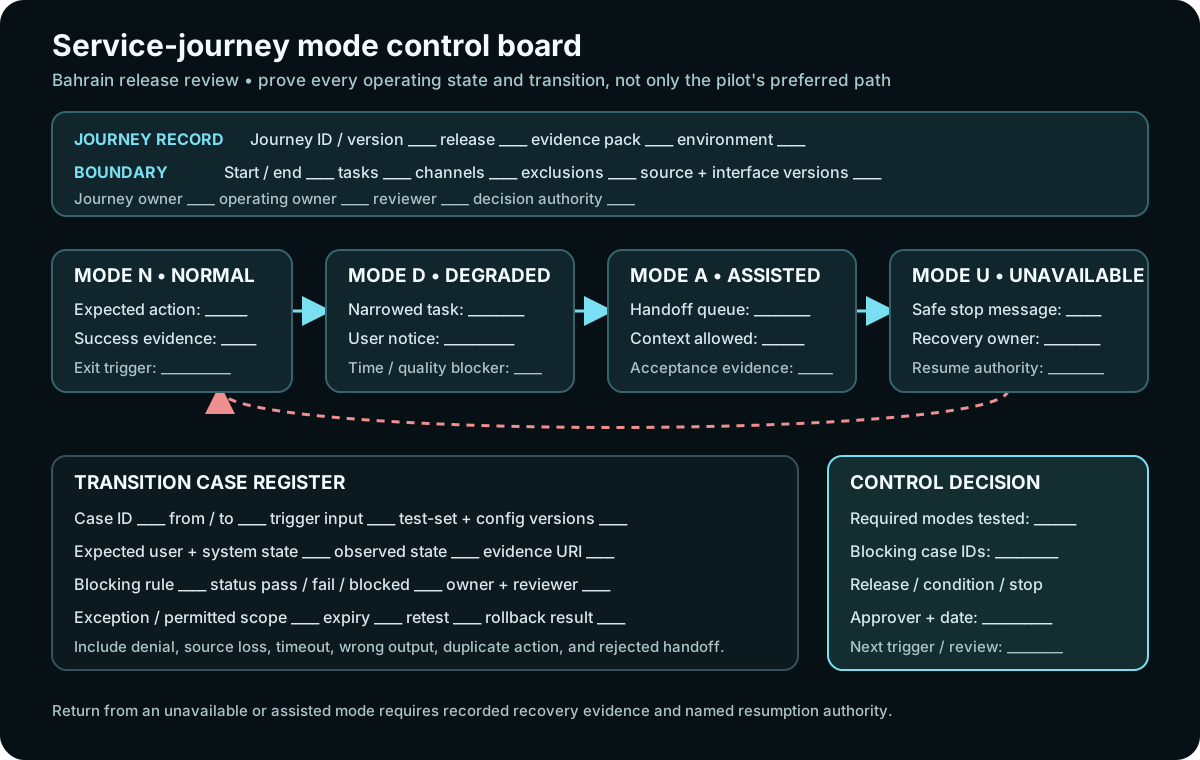
A pilot usually demonstrates one preferred route under attentive supervision. The test user chooses expected inputs, the source is available, the model endpoint responds, and someone nearby can explain a confusing result. A live service journey has no such courtesy. A source can be stale, an identity can be incomplete, an interface can time out after changing state, an operator can reject a handoff, and a user can return while recovery is still underway.
The release question is therefore not whether the pilot can be repeated. It is whether the same bounded journey has defined, truthful and tested behavior in every operating mode that users may encounter—and whether authorized owners can move it between those modes. Normal operation is only one state. Degraded, assisted, unavailable, recovery, and rollback behavior belong in the decision.
Bahrain’s official Digital-First Principle page provides a public policy direction for digital service development. The Digital Economy page places artificial intelligence and emerging technology in broader transformation context. The iGA site exposes institutional context for digital services and operations, while the CBB FinTech and Innovation page concerns financial innovation and a regulatory sandbox. These references make service continuity, channels, operations, and sector boundaries relevant topics. They do not verify any particular journey or grant approval to release it.
Freeze the journey as a sequence of authoritative states
Choose one journey and give it a stable ID and version. Write its starting condition, completed condition, user-visible milestones, and authoritative system of record. An AI component may classify a request, retrieve support, extract fields, draft a response, route a case, or recommend an action. State which of those outputs are advisory and which can influence a stored decision or transaction.
Map every transition: user input, identity check, source lookup, AI processing, confidence or rule decision, user confirmation, business API, notification, evidence capture, and human review. For each transition, name the owner, interface contract, timeout behavior, retry rule, and permitted result. A fluent response is not authoritative if the business system rejected the update. A successful back-end action is not safely complete if the user was told it failed and retries it.
The release record should freeze the workflow code, model, prompt or orchestration, source snapshot, extraction and retrieval settings, policy configuration, interface versions, test set, and environment. Record what was not tested. Pilot access to sample material does not authorize a broader corpus, another user group, or another channel.
Define four user-visible operating modes
A mode is a controlled combination of capability, user message, system behavior, ownership, and exit criteria. Avoid an unlabeled middle state where the service silently does less than users expect.
Normal mode
Normal mode permits the reviewed tasks for the reviewed users, sources, channels, and configuration. The service should show accurate transaction state, preserve required source or decision evidence, and generate the expected operational signals. Success is measured at the journey outcome, not merely at the AI component response.
Degraded mode
Degraded mode deliberately narrows capability. Retrieval may be limited to a verified source subset; generation may be disabled while authorized search remains; an extraction path may accept uploads but hold them for review; a transactional flow may become enquiry-only. The user should receive a truthful message and an alternative where one has been approved. Define a maximum allowed condition or a blocking threshold through customer review rather than publishing a universal duration.
Assisted mode
Assisted mode transfers the task to a person or another authorized channel. The receiving operator needs confirmed identity state, language or channel context, completed steps, unresolved issue, authoritative business state, allowed source references, and reason for transfer. The handoff must not copy unreviewed model output into a decision field. Test that the operator can accept or reject the case and that the user is not forced to repeat information the receiving role is authorized to see.
Unavailable mode
Unavailable mode stops the affected boundary. It should prevent false success, duplicate action, unauthorized fallback, and fabricated status. Record the user message, support path, evidence preserved, recovery owner, and person who can authorize resumption. A generic error page with no ownership or state protection is not an operating mode.
Test transitions, not only steady states
Many faults occur while the journey changes mode. Create cases for normal-to-degraded, degraded-to-assisted, assisted-to-unavailable, unavailable-to-recovery, and recovery-to-normal. Also test rollback from a newly released configuration to the last accepted version.
Inject conditions at realistic boundaries: source becomes unavailable after retrieval begins; identity expires before a write; model responds after the business deadline; API times out with uncertain completion; duplicate submission arrives; citation target changes; human queue rejects a case; notification fails after a successful action; cache retains the previous mode. Specify expected user and system states before each test.
A transition passes only when both states reconcile. If a timeout occurs after a write, the result cannot be classified from the client error alone. Query or reconcile the authoritative system, apply the idempotency rule, and tell the user only what is known. If the state remains uncertain, hold the journey and assign an owner rather than producing a confident completion message.
Recovery tests should prove that corrected dependencies, caches, pending actions, and operator queues are consistent. They should also show that traffic does not resume merely because a health check turned green. Resumption requires named authority and evidence for the affected cases.
Preserve user truth across AI and business systems
The service must distinguish AI uncertainty from business-state uncertainty. A low-confidence extraction may require field confirmation. An unsupported answer may require refusal. A delayed transaction may require reconciliation. These are different paths with different evidence and owners.
Keep the authoritative original beside derived representations where the customer permits it. For document extraction, link fields to page locations and extraction version. For retrieval, link material claims to eligible source versions. For drafting, show whether a person accepted or changed the proposal before it affected the record. For routing, preserve the rule or classification that selected the queue and provide a correction route.
Monitor journey states: completions, validation failures, uncertain transactions, repeat submissions, transfers, operator rejections, unavailable-mode entries, recovery attempts, source errors, and unresolved cases. Segment only as allowed by the customer’s data and privacy decisions. A component availability chart cannot reveal a user trapped between an AI response and an unconfirmed business action.
Treat financial and other sector settings as separate envelopes
The CBB page provides official financial-innovation context, but it does not turn a generic AI test into financial-sector release evidence. A financial workflow should identify its own customer legal, risk, security, privacy, operations, records, technology, and sector reviewers. They decide applicability, permitted data, customer communication, confidentiality treatment, evidence, and acceptance.
The same separation applies to public services, healthcare, telecom, education, and enterprise operations. Do not reuse one sector’s exception, threshold, or human-review pattern without a new decision. Hosting, retention, cybersecurity, procurement, privacy, accessibility, and legal conclusions remain with qualified customer reviewers; engineering records their approved inputs and observed implementation.
Complete text equivalent: service-journey mode board
The tables below contain the entire decision content of the SVG. Use the cover for one journey release, complete one mode definition per allowed mode, then add a case row for every transition, recovery and rollback condition.
| Cover field | Required entry |
|---|---|
| Journey identity | Journey ID and version, release ID, evidence-pack version, environment and review date |
| Boundary | Start and end states, users, tasks, channels, source systems, business interfaces, human queues and exclusions |
| Configuration | Test set, source snapshot, extraction, retrieval, model, prompt or orchestration, policy, workflow and interface versions |
| Authority | Journey owner, source owner, operating owner, assisted-service owner, incident owner, reviewer, rollback authority and resumption authority |
| Mode | Required definition | Exit or blocking rule |
|---|---|---|
| N — normal | Allowed users and tasks, authoritative outcome, user message, evidence events, service owner and monitored state | Leave normal mode when a named source, identity, AI, interface, queue or evidence condition crosses its approved trigger |
| D — degraded | Narrowed capability, excluded actions, user notice, retained evidence, alternative route, owner and maximum reviewed condition | Stop or enter assisted mode when the permitted degradation boundary is exceeded or its state cannot be established |
| A — assisted | Transfer trigger, receiving role and queue, allowed context, operator acceptance or rejection, user expectation and unresolved-state owner | Enter unavailable mode if the queue cannot accept the case or required authorized context cannot be transferred |
| U — unavailable | Stopped boundary, safe user message, transaction protection, evidence preservation, support route and recovery owner | Resume only after affected cases pass, open states reconcile and named resumption authority records acceptance |
| Transition-case field | Required entry |
|---|---|
| Identity and trigger | Case ID; from-mode and to-mode; injected source, identity, AI, interface, queue or operator condition |
| Executed setup | Test-set and material references; source, model, prompt, policy, workflow and interface versions; environment |
| Expected state | Expected user message, system-of-record state, prohibited result, trace event, handoff or safe stop |
| Observed evidence | Actual user and system states, evidence URI, executor, execution date, reviewer and review date |
| Decision rule | Threshold or blocking rule, pass / fail / blocked, blocking reason and affected scope |
| Exception | Exception ID, rationale, permitted and prohibited scope, owner, evidence, expiry and retest trigger |
| Recovery | Containment, rollback or isolation action; reconciliation result; operator acceptance; recovery proof; resumption authority |
| Final control decision | Required entry |
|---|---|
| Coverage | Required modes and transitions, total cases, passed, failed and blocked counts, and every blocking ID |
| Conditions | Accepted exceptions, narrowed scope, owners, expiry dates and monitoring required while conditions remain |
| Decision | release, release-with-conditions or stop; release ID, decision owner, approver and date |
| Revalidation | Next review date plus source, model, prompt, policy, interface, queue, ownership and incident triggers |
Release one operated journey, not a permanent label
A case that was not executed is blocked. A mode without a truthful user message, accountable owner, measurable entry condition, and tested exit is undefined. A handoff that the receiving operator has not accepted is incomplete. A recovery without resumption authority cannot return the service to normal.
The final decision applies only to the journey, release, configuration, users, tasks, channels, and exclusions recorded in the board. It does not establish that an AI system is generally suitable for Bahrain, that a public policy page approves the workflow, or that a financial service has regulator acceptance. It shows something smaller and operationally useful: named reviewers accepted a versioned journey whose normal and adverse states were observed, whose owners can act, and whose changes will return to review.
Annotated primary sources
What the public material supports—and what it does not
These official pages provide bounded public context. They do not prescribe this design, decide a customer’s obligations, or establish any LangData affiliation or conformity.
-
1.Bahrain National Portal — Digital-First Principle
Supports: Official public context describing Digital First as a policy direction and a first channel for public-service development in Bahrain.
Boundary: It does not prove that a particular service is digital-only, complete, accessible, reliable, AI-enabled, or implemented by LangData, and it does not prescribe this release method.
-
2.Bahrain National Portal — Digital Economy
Supports: Official context for Bahrain digital transformation, digital-government, infrastructure, emerging technology, artificial intelligence, inclusion, and a national digital-economy strategy.
Boundary: The page does not establish current performance for a specific journey, buyer demand, a mandatory AI architecture, official endorsement, or customer outcomes.
-
3.Information & eGovernment Authority
Supports: Official institutional context for integrated digital services, digital transformation, systems, statistics, emerging technologies, service channels, and customer-facing operations.
Boundary: A homepage and service inventory do not verify a particular integration, operating model, service level, system access, approval, procurement status, or LangData delivery history.
-
4.Central Bank of Bahrain — FinTech & Innovation
Supports: Official financial-sector context for digital transformation, fintech innovation, an agile regulatory environment, and the Regulatory Sandbox.
Boundary: It does not establish sandbox participation, CBB approval, release acceptance, legal conformity, customer confidentiality controls for this workflow, or requirements outside the relevant financial context.
Review the operating boundary before choosing the stack.
Bring one workflow, its approved source inventory, and the people who own authorization, review, and incidents.
Discuss the architecture review