Topic review
Bahrain data publication lifecycle: source, refresh, withdrawal, and reuse evidence
An operating review for Bahrain data products that records producer releases, consumer dependencies, corrections, supersession, and withdrawal across files, APIs, metrics, and dashboards.
- Published by
- LangData Editorial, Editorial and architecture team
- Review owner
- Sourav Chandra, Co-Founder, LangData · Approved
- Published
- Updated
Swipe or scroll horizontally to inspect the full diagram.
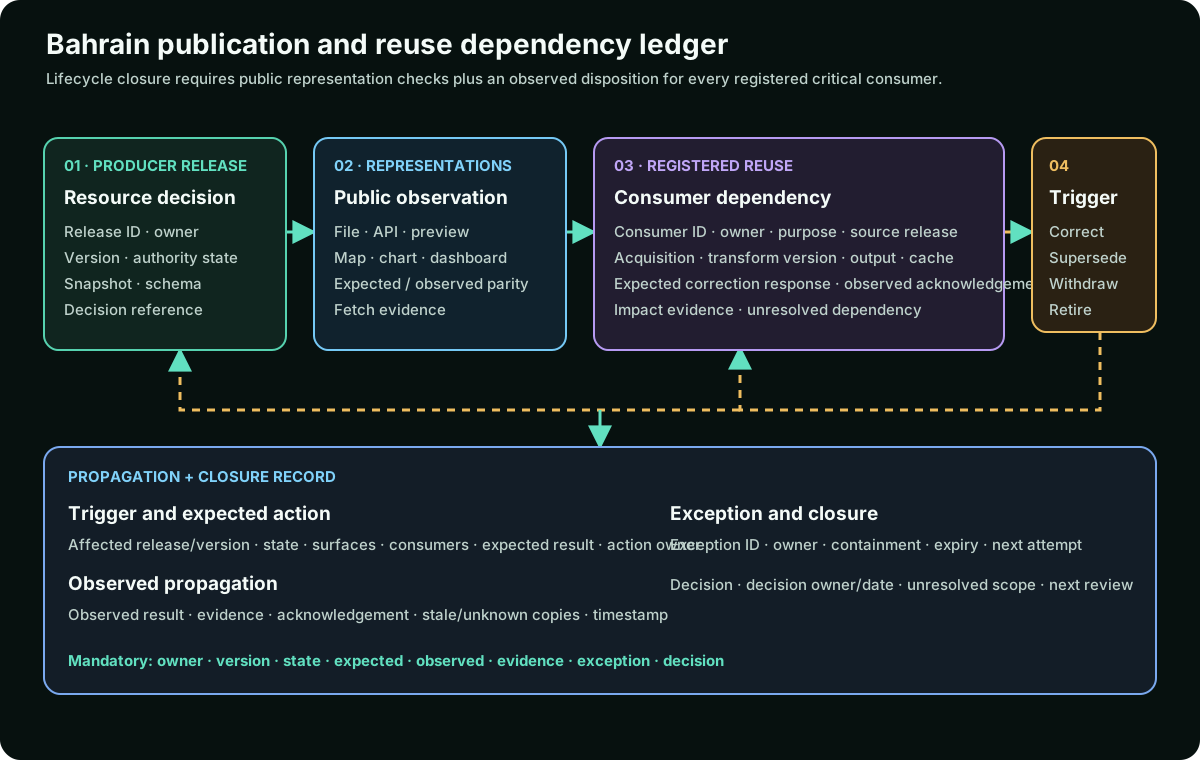
Data publication is often measured at the producer boundary: a file was uploaded, a catalog record changed, or an API job completed. Reuse happens beyond that boundary. An analyst imports the file into a model, a dashboard caches a measure, a mobile service copies a lookup table, or a research team cites an edition. When the producer corrects or withdraws a release, those consumers may continue serving the old result with no visible link back to the source decision.
A Bahrain data lifecycle should therefore be reviewed as a producer-consumer dependency system. Every release needs an identity, authority state, version, evidence, and owner. Every important reuse needs a registered consumer, purpose, transformation, output, and contact. Correction and withdrawal are complete only when all in-scope representations change and critical consumers receive a disposition.
The Bahrain Open Data Portal visibly provides dataset discovery alongside data-request, statistics-report, map, chart-building, and API or documentation routes. The Information and eGovernment Authority identifies operations and governance, digital transformation, and statistics and population as business lines. The National Portal’s Digital Economy page offers public digital context, while the National Portal provides wider service and information context.
These sources support a Bahrain-specific reason to treat published data as an operated public interface. They do not demonstrate that one dataset is accurate, current, accessible by API, reusable under a stated licence, or synchronized across a map and a download.
Give every release an identity that survives correction
Create a release ID that binds dataset, resource, edition or period, source snapshot, schema version, publication version, and authority state. Preserve this ID in catalog metadata, file naming or headers where possible, API responses, quality evidence, and consumer records. A URL alone is unstable: content can be replaced while links and caches retain older bytes.
Authority states should distinguish draft, approved for release, current, corrected, superseded, withdrawn, and retired. A correction creates a new version linked to the affected release and reason. Supersession may retain the earlier version for historical reproducibility under an owner-approved rule. Withdrawal means the producer no longer authorizes active serving through the in-scope channels; it does not mean the historical event disappears from the decision record.
The source owner supplies disclosure, classification, licence, retention, and revision decisions through the customer’s governance. Engineering can enforce state and expose evidence. It cannot infer authority from an official domain or determine whether a resource should be public.
Register reuse that matters before an incident
Not every casual download can be tracked. Define critical consumers: official or customer-operated dashboards, public services, scheduled reports, decision systems, data products, models, research outputs, and partner interfaces whose stale state would create material confusion or harm. For each, record consumer ID, owner, purpose, source release, acquisition route, transformation, output, refresh behavior, cache, contact, and expected response to correction.
Registration may occur through API credentials, subscriptions, catalog declarations, pipeline scanning, or owner-managed inventories. Public anonymous reuse remains possible, so the dataset page and resource metadata should expose stable release and correction information that an unknown user can check. The system should be honest about the limit: “registered consumers acknowledged” is not “every copy was updated.”
Consumer contracts can also return useful observations. A dashboard may detect a missing category; a user may report a label error; a downstream reconciliation may expose a producer defect. Route these findings to the source owner with the release ID and evidence instead of allowing ad hoc edits in the consuming product.
Text equivalent: publication and reuse dependency ledger
The diagram is a compact view of the following record. This table contains the full operational alternative for screen readers and for teams adapting the workflow.
| Ledger stage | Required record | Completion test |
|---|---|---|
| Producer release | Release ID, dataset/resource ID, source owner, steward, source snapshot, version, state, scope, and authority decision reference | The released bytes and metadata can be tied to a named owner decision |
| Representation check | Expected and observed file, API, preview, map, chart, or dashboard versions; schema; selected reconciliations; public-fetch evidence | Representations that claim the same release agree or disclose their difference |
| Consumer dependency | Consumer ID, owner, purpose, acquisition route, source release, transformation version, output, cache, and contact | Critical reuse can be traced from source release to user-facing result |
| Trigger | Correction, supersession, withdrawal, late refresh, schema change, access change, or licence-decision change; detected time and initiator | The affected release and consumer set are queryable |
| Propagation | Required action per representation and consumer, expected result, observed result, evidence link, acknowledgement, and failed action | Stale copies and unknown responses remain open exceptions |
| Exception | Exception ID, affected scope, owner, rationale, containment, expiry, next attempt, and risk disposition from the proper reviewer | An exception cannot silently convert the old release into current data |
| Closure decision | corrected, superseded, withdrawn, partially-propagated, or closed; decision owner/date; unresolved dependencies; next review | Closure language matches observed propagation rather than intent |
| Mandatory cover | Owner, version, state, expected, observed, evidence, exception, and decision | A reviewer can distinguish what should happen from what did happen |
Reconcile representations before announcing a release
A portal page may combine a preview table, file, API, chart, map, and explanatory text produced by different jobs. Release testing should fetch each representation through its public route and compare the release ID or source snapshot, schema, units, period, category labels, row/key aggregates, selected values, and revision notice. If a map applies a geographic transformation or a chart applies a filter, document it as a derived representation rather than calling it identical.
Record access observations precisely: public without authentication during the test, authenticated under a named customer account, documentation-only, unavailable, or not tested. Do not translate an “API” navigation item into a claim that every resource has an endpoint. Similarly, a CSV extension does not prove stable machine readability; inspect encoding, delimiters, headers, types, and malformed rows.
Licensing needs a resource-version decision reference. A portal can expose terms or licence material, but applicability and rights may vary by resource, third-party input, attachment, jurisdiction, or use. Qualified customer policy and legal reviewers decide. Engineering can block release when that reference is missing and expose the approved attribution or restriction notice.
Design correction as a forward-moving release
A correction should not overwrite history without trace. Record the original release, defect, affected fields or periods, discovery source, impact assessment, corrected version, validation cases, owner decision, and effective time. Publish a change note that enables a consumer to determine whether its output is affected. Where historical access remains, mark the prior version clearly and prevent it from appearing current.
Propagate the corrected release through caches, search indexes, API materializations, chart stores, geospatial tiles, download mirrors, and customer-operated derivatives inside the agreed boundary. Then test what users actually receive. Internal job success is evidence only for one stage.
Consumers need acknowledgements at an appropriate grain. An owner might state that the release was ingested, that a metric was recalculated, that no affected field was used, or that correction is scheduled under an accepted exception. Preserve the observation and evidence. A distribution email proves notice was sent, not that a dashboard changed.
Make withdrawal visible and reversible only by decision
Withdrawal triggers can include source-owner instruction, disclosure concern, unresolved quality failure, supersession without historical serving, licence uncertainty, or security investigation. This article does not decide when any trigger applies. Once the owner and qualified reviewers issue a decision, the platform should prevent new serving, update metadata, invalidate controlled caches, stop republishing jobs, and mark consumer dependencies for action.
For unknown public consumers, provide a durable tombstone or status response where the owner’s policy permits, identifying the withdrawn release and a contact or replacement without exposing sensitive rationale. For registered consumers, issue a machine-readable event plus a human notice. Test both. Preserve evidence under customer-approved records and access rules.
Restoring a withdrawn resource is a new decision. Require a corrected or reauthorized version, new evidence, resolved exception, and release owner approval. A deploy rollback should not accidentally republish it; include withdrawal state in recovery tests.
Use consumer impact to prioritize operations
Monitoring should show missed source expectations, failed public fetches, representation mismatches, open corrections, unacknowledged critical consumers, stale caches, expired exceptions, and incomplete withdrawals. Prioritize by customer-defined consequence: a public information chart and an internal exploratory notebook may require different responses, even when they share a source.
Run periodic dependency exercises. Select an approved synthetic release, publish it through the relevant surfaces, register test consumers, correct one field, supersede the release, then withdraw it. Measure observed propagation and operator work. The team can then decide which integrations need automation, which depend on manual acknowledgement, and where scope remains unknowable.
The final decision record should be exact. It can say that release B replaced release A, all controlled representations reconciled, three registered critical consumers acknowledged, one accepted exception remains until a named date, and anonymous copies are outside the boundary. It should not say that all reuse everywhere is correct.
That modest language is operationally strong. It turns Bahrain data publication from an upload event into a traceable relationship among producer decisions, public representations, downstream use, and recovery when the published truth changes.
Annotated primary sources
What the public material supports—and what it does not
These official pages provide bounded public context. They do not prescribe this design, decide a customer’s obligations, or establish any LangData affiliation or conformity.
-
Supports: The official portal exposes dataset discovery together with visible routes for data requests, statistics reports, maps, chart-building, and API or documentation context.
Boundary: The portal's reachability does not prove resource quality, freshness, completeness, machine readability, API availability, reuse, licensing rights, or that different representations agree.
-
2.Information and eGovernment Authority, Kingdom of Bahrain
Supports: The official iGA site visibly identifies operations and governance, digital transformation, and statistics and population among its main business lines.
Boundary: This institutional context does not prescribe the lifecycle in this article, certify an implementation, grant access, or establish the status or suitability of a particular dataset.
-
3.Bahrain National Portal — Digital Economy
Supports: The official national-portal page presents digital transformation, regulatory framework, digital infrastructure, and a National Digital Economy Strategy as public context.
Boundary: It does not prove data-platform outcomes, adoption, current program status across every entity, LangData participation, or any legal, security, hosting, disclosure, or reuse requirement.
-
4.Kingdom of Bahrain National Portal
Supports: The official portal provides government-service, directory, participation, and national-information context in which published data may be discovered and reused.
Boundary: A functioning national portal does not establish a technical interface, data entitlement, service level, publication duty, or government relationship for LangData.
Review the operating boundary before choosing the stack.
Bring one workflow, its approved source inventory, and the people who own authorization, review, and incidents.
Discuss the architecture review