Topic review
Kuwait AI service operations: evidence before release
A Kuwait-focused method for reconciling positive tests, negative tests, evidence age, configuration, exceptions, and accountable decisions before an AI-enabled service is released.
- Published by
- LangData Editorial, Editorial and architecture team
- Review owner
- Sourav Chandra, Co-Founder, LangData · Approved
- Published
- Updated
Swipe or scroll horizontally to inspect the full diagram.
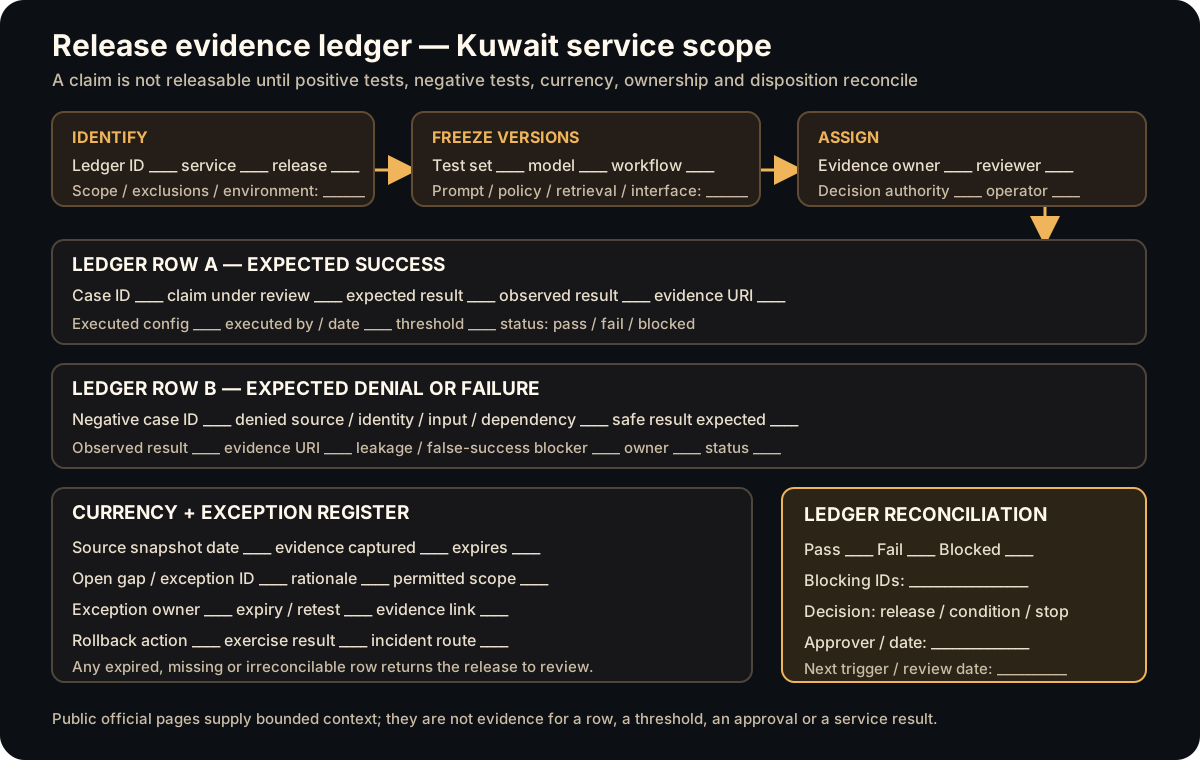
A release pack can contain many documents and still fail to answer the decisive question: which exact evidence supports the decision for this exact service version, and which expected failures were actually observed? Teams often preserve screenshots of successful answers while negative tests remain in chat messages, configuration changes are undocumented, and an old demonstration is presented beside a newer model. The volume of material creates confidence without reconciliation.
For a Kuwait-focused AI service, the first discipline is to resist blending different public contexts into one supposed national architecture. A CITRA news item from 2018 records discussion of AI, cloud computing, digitization, people, data, and process. The Central Bank of Kuwait Wolooj overview describes an interactive testing environment in a financial-innovation setting. The official KDIPA event record from 2024 describes discussion of digital payments, AI technologies and innovative tools, economic growth, sustainability, and workforce readiness. These are different institutions, dates, and purposes. They justify careful scoping; they do not combine into a current government-wide specification.
The operating thesis is therefore about proof discipline: a service should not be released until every material assertion has a current positive case, a corresponding denial or failure case, frozen configuration, durable evidence, an owner, and a disposition that reconciles with the final decision. Missing evidence is a visible state. It is never converted to “pass” because the demonstration looked plausible.
Build the ledger around assertions, not documents
A release assertion is a testable sentence about one bounded behavior. Examples include: “an authenticated user receives only eligible sources,” “a failed business write cannot be described as successful,” “a withdrawn procedure stops appearing in current answers,” or “an unavailable model routes this journey to the approved manual path.” Each assertion receives an ID and links to one or more cases.
Do not write broad assertions such as “the service is secure,” “Arabic is supported,” or “the platform is ready.” Those statements hide many independent decisions. Break them into identity, source, extraction, retrieval, language direction, citation, transaction, logging, human review, incident, and recovery behavior according to the actual journey.
The ledger header freezes the object being judged: service and release IDs, environment, included users and tasks, excluded paths, source snapshot, test-set version, model and prompt versions, retrieval configuration, policy configuration, workflow code, interface contracts, and evidence-pack version. If a row was executed against a different configuration, mark it stale or inapplicable rather than attaching it to the release.
Pair every success with a meaningful negative case
A positive case asks whether the intended action succeeds under approved conditions. A negative case asks whether the service refuses, narrows, escalates, or stops when a boundary is crossed. Both are necessary because an AI workflow can appear accurate while ignoring permission, source status, or business state.
For retrieval, pair an answerable question with an unsupported question, an allowed identity with a denied identity, a current source with a withdrawn version, and a clean document with a quarantined extraction. For transaction assistance, pair a successful write with validation rejection, timeout after uncertain completion, duplicate request, stale version, and downstream unavailability. For a human queue, pair accepted handover with an unauthorized recipient, missing context, queue closure, and operator rejection.
The expected negative result must be written before execution. “The service should handle it safely” is too vague. Specify the visible message, system state, prohibited output, trace event, escalation target, and recovery option. Then record the observed result. A blocked test—perhaps because an interface was unavailable or a test identity was not approved—remains blocked. It does not disappear from the count.
Negative evidence also guards against an easy evaluation error: treating absence of a reported problem as proof that the control worked. A log with no unauthorized events might mean no denied case was attempted, the event was not logged, or the query failed earlier. The ledger should link the test input, expected event, observed trace, and reviewer classification.
Keep evidence provenance and age beside the result
Evidence is useful only when a reviewer can identify what produced it. Each row should capture executor and execution date, environment, component and configuration versions, approved test-material reference, expected result, observed result, evidence URI, review date, and reviewer. Store source material and sensitive outputs in the customer’s approved evidence system; the ledger can retain controlled references.
Add a currency field. A permission test may become stale when role mappings change. A retrieval case may need rerun when the corpus, extraction, chunking, embedding, ranking, prompt, or model changes. A transaction case may expire when an API contract changes. An operator-acceptance test may be invalid when the queue or duty roster changes.
Use both calendar expiry and event triggers where appropriate. A date prevents evidence from remaining open-ended; an event trigger catches important changes before the date. The release owner should be able to query all rows invalidated by a changed component. If that mapping is impossible, the evidence pack cannot reliably describe the current service.
Make contradictions first-class review material
Real test packs contain contradictory evidence. A query can pass in one run and fail after cache warm-up. Authorization can work in retrieval but leak through an answer cache. An interface can return an error while the remote transaction succeeds. Arabic and English paths can select different source versions. Do not average these away.
Open a discrepancy record that links the conflicting rows, configuration differences, likely cause, correction owner, and retest. Until the discrepancy is resolved or accepted as a scoped exception by the authorized decision owner, the affected assertion remains failed or blocked. A later passing run does not erase the earlier failure; it should link to the change and show why the correction is credible.
The same rule applies to missing logs. If expected telemetry cannot be found, the team lacks evidence for that case even when the user-visible result looked correct. Observability is part of the reviewed behavior when it is needed for incident response or later reconstruction.
Keep Kuwait context attached to the service envelope
The service envelope states which institutional and sector reviewers need to participate. A financial workflow may require customer legal, risk, security, privacy, records, operations, and sector specialists. A communications or digital-service workflow may have a different group. Public pages can help teams notice relevant subject areas; they cannot determine who is in scope, which current rules apply, or whether a control is sufficient.
The Wolooj page is useful evidence that testing and innovation are visible in a CBK context. It is not a substitute for a customer’s release decision and should not be used to imply sandbox participation or approval. The CITRA item is dated context, not proof of a present technical environment. The KDIPA event records discussion, not implementation. Frontmatter annotations preserve these boundaries so later editors do not turn context into a claim.
Deployment, hosting, data location, retention, privacy, cybersecurity, procurement, and sector obligations remain customer decisions with qualified Kuwait reviewers. The ledger should record approved inputs and evidence references, not declare legal conformity.
Put exceptions on a clock and a scope
An exception record must identify the failed or blocked case, reason, permitted users and tasks, prohibited scope, compensating action, owner, evidence link, expiry, and retest trigger. “Known limitation” is not a decision. A condition without an owner or end point can become permanent through neglect.
If the exception removes a required language path, document family, source, integration, or action, that removal must appear in user and operator scope. Monitoring should be able to detect attempts to enter the excluded path. When an exception expires, the affected release assertion returns to review automatically; it does not continue on the strength of the old meeting.
Rollback evidence belongs in the same record. State the release or component to restore, the data or index reconciliation required, cache actions, user-routing change, operator authority, and exercise result. A written command that has never been attempted is a proposed control, not observed evidence.
Complete text equivalent: Kuwait release evidence ledger
These tables contain every field represented in the SVG and can replace it in a release meeting. Complete the identity table once, use paired rows for each assertion, and reconcile the decision table without omitting failed, blocked, contradictory, or expired records.
| Ledger identity field | Required entry |
|---|---|
| Review object | Ledger ID, service or journey ID, release ID, environment, evidence-pack version and review date |
| Scope and exclusions | Included users, roles, tasks, sources, languages, channels and actions; explicitly excluded paths |
| Frozen configuration | Source snapshot, test-set version, extraction, retrieval, model, prompt, policy, workflow and interface versions |
| Accountability | Assertion owner, evidence owner, operator, incident owner, reviewer, exception owner and final decision authority |
| Evidence validity | Capture date, expiry date, component-change triggers and owner responsible for revalidation |
| Row type | Required case record | Blocking interpretation |
|---|---|---|
| Positive evidence | Assertion ID, case ID, approved input reference, expected success, observed user and system state, evidence URI, executed versions, executor/date, reviewer/date and status | A required success not observed on the frozen release is fail; a case that cannot establish a result is blocked |
| Negative evidence | Paired case ID, denied identity/source/input/dependency, expected refusal or safe failure, prohibited result, observed state, trace URI, executed versions, owner and status | Unauthorized access, false success, duplicate action, unsupported answer, missing required trace or unsafe fallback blocks the assertion |
| Contradiction | Conflicting row IDs, configuration difference, cause hypothesis, change reference, correction owner, retest evidence and reviewer | An unexplained contradiction leaves the affected assertion failed or blocked even if one run passed |
| Currency | Source snapshot date, evidence capture date, expiry, event triggers, last validation and responsible owner | Expired or configuration-mismatched evidence cannot support the current release |
| Exception | Failed or blocked ID, rationale, allowed and prohibited scope, compensating action, evidence link, owner, expiry and retest | An exception without explicit scope, authority and expiry is not acceptable evidence |
| Recovery | Rollback target, source/index/cache reconciliation, manual route, incident link, exercise result, recovery owner and resumption authority | Untested or unauthorized rollback leaves the related operating assertion blocked |
| Reconciliation field | Required entry |
|---|---|
| Counts | Total assertions and cases; passed, failed, blocked, expired and contradictory counts |
| IDs | Every blocking case, open discrepancy and accepted exception ID |
| Scope after conditions | Exact users, tasks, sources, languages, channels or actions removed from release |
| Decision | release, release-with-conditions or stop; approver, decision owner, release ID and date |
| Follow-up | Exception expiry, next review date, event triggers, required retests and accountable owner |
A release statement should be smaller than its evidence
The final statement should identify the reviewed service and release, accepted scope, configuration, test-set version, case disposition, open conditions, rollback state, owners, and next trigger. It should not become “Kuwait AI approved,” “regulator ready,” or a claim about a whole language, model, platform, or institution.
An evidence ledger is intentionally conservative. It reveals when material is old, when two tests disagree, when a negative path was never executed, and when an exception has no end. That friction is valuable: it prevents a compelling demonstration or public event reference from carrying more weight than the observed behavior of the service being released.
Annotated primary sources
What the public material supports—and what it does not
These official pages provide bounded public context. They do not prescribe this design, decide a customer’s obligations, or establish any LangData affiliation or conformity.
-
1.CITRA — AI and cloud workshop news
Supports: A 2018 official CITRA news item reporting workshop discussion of artificial intelligence, cloud computing, government digitization, and the relationship among people, data, processes, and technology.
Boundary: It is an older event report, not evidence of current adoption, a Kuwait-wide control model, service performance, mandatory architecture, procurement, or LangData participation.
-
2.Central Bank of Kuwait — Innovation Hub “Wolooj” overview
Supports: Official CBK context for an interactive testing environment addressing artificial intelligence, digitalization, information security, fintech, and supervisory or regulatory technology.
Boundary: The page concerns the CBK innovation-hub context; it does not establish participation, approval, legal sufficiency, release readiness, customer results, or requirements for unrelated Kuwait services.
-
3.Kuwait Direct Investment Promotion Authority — Accelerating Technology and AI Implementation event
Supports: The official 2024 record describes discussion of digital payments, AI technologies and innovative tools, economic growth, sustainability, and workforce readiness in a Kuwait investment context.
Boundary: A roundtable record does not prove market demand, implementation status, procurement opportunity, business outcomes, official endorsement of this method, or a LangData relationship.
Review the operating boundary before choosing the stack.
Bring one workflow, its approved source inventory, and the people who own authorization, review, and incidents.
Discuss the architecture review