Topic review
A Kuwait data-platform decision guide: contracts, quality, lineage, and operations
A decision method for Kuwait data teams to turn changing statistical and operational sources into versioned data products with reconciled metrics, lineage, and owned failure paths.
- Published by
- LangData Editorial, Editorial and architecture team
- Review owner
- Sourav Chandra, Co-Founder, LangData · Approved
- Published
- Updated
Swipe or scroll horizontally to inspect the full diagram.
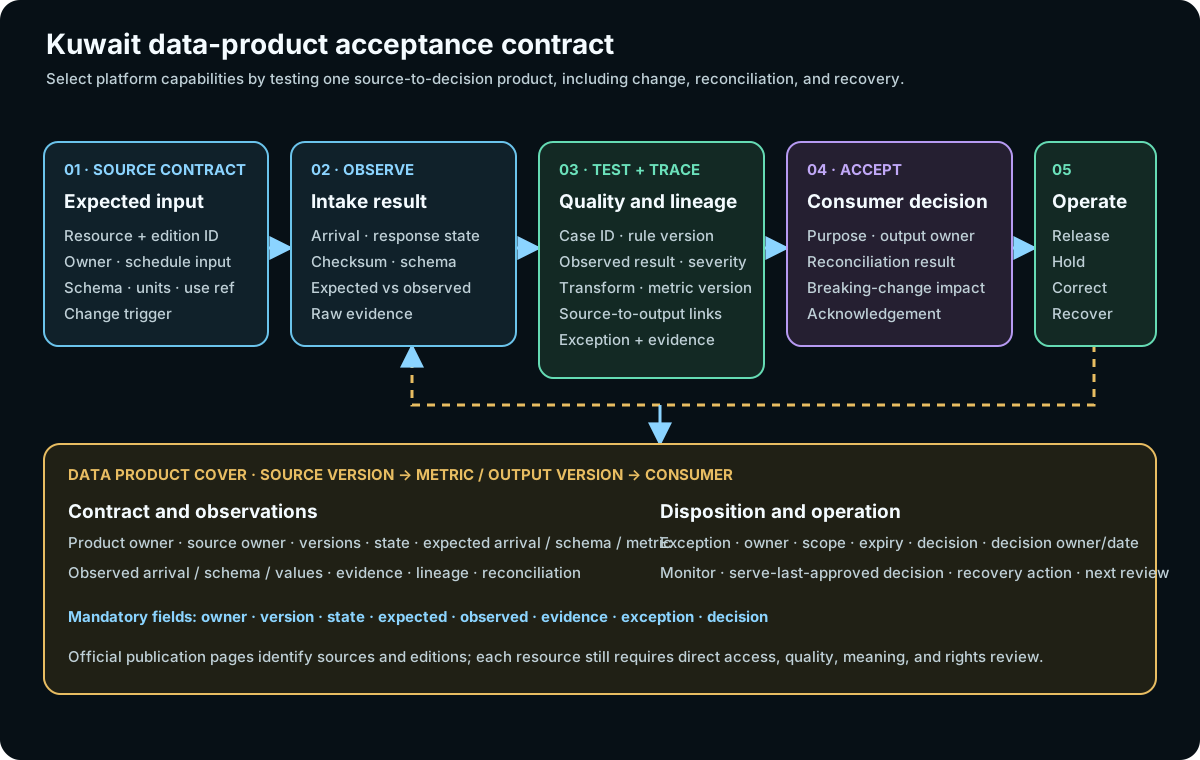
The weakest data-platform decision starts with a product category: warehouse, lakehouse, streaming stack, semantic layer, or business-intelligence suite. The strongest starts with a disagreement that must be resolved. Which edition of a public series fed the metric? Did a source arrive when expected? Was a revised value propagated to every report? Can an operator find the transformation that changed it? Who decides whether a broken feed pauses publication or serves the last approved result?
A Kuwait platform should be selected against these decision and operating needs, not against a feature inventory. Public statistical sources make the problem concrete. The Kuwait Central Statistical Bureau presents statistical releases, reports, projects, and subject areas. Its dedicated Statistical Publication Plan and Annual Statistical Collection routes show that schedules and named editions are part of the visible publishing environment. CITRA’s Reports and Data index shows another official file-and-report context.
Those pages do not prove that a particular file is complete, current, licensed for a proposed use, available through an API, or stable across editions. The engineering recommendation is to build a contract and evidence chain around each required resource, then use those records to evaluate platform options.
Begin with one data product and one decision
Define a data product as a bounded output used by a named consumer: an approved management metric, operational queue, reconciled statement, research table, service-quality indicator, or model feature set. Give it an ID, owner, consumers, decision purpose, refresh expectation, source inventory, definitions, sensitivity classification supplied by the customer, and permitted-use reference.
The product boundary includes the less visible path: landing area, parser, transformation, lookup tables, manual adjustment, quality results, semantic definition, serving layer, export, dashboard, notebook, alert, cache, archive, and recovery copy. State exclusions. If an analyst still pastes a value into a spreadsheet before the board sees it, that step is part of the lineage, not an inconvenience to omit.
Record the question the platform must answer. Examples include: Can operators reproduce a released number from a named source edition? Can a late input be isolated without silently mixing periods? Can consumers see a revision and its impact? Can an authorization change propagate to extracts and downstream services? The option assessment becomes evidence-based when these questions have test cases.
Contract a source without pretending to own it
A source contract records observed technical and operational behavior rather than making promises on behalf of the publisher. It should contain source and resource IDs, source owner, acquisition route, expected edition or schedule reference, file or interface pattern, format, encoding, schema, keys, units, period fields, revision marker, access condition, permitted-use decision reference, and escalation contact where available.
Expected arrival comes from a current owner-approved input. The publication-plan route can prompt the field, but an engineer should not translate a page title into a service guarantee. Store the observed arrival time, version or edition label, checksum, response status, size, and schema result for each run. Distinguish not released, not found, access denied, format changed, late under the customer rule, and retrieval failed; collapsing these into “missing data” prevents correct escalation.
Contracts also describe change detection. A new column, revised historical file, category change, encoding change, replaced attachment, or new URL may be intentional. Quarantine first, compare with the previous accepted version, link the diff, and ask the product owner for a disposition. Automatic adaptation is useful only when the accepted compatibility rule permits it.
Text equivalent: data-product acceptance contract
The artifact above is fully represented by this operational table. Teams can implement it in a ticketing, catalog, quality, or release system without relying on the image.
| Board lane | Required fields and evidence | Acceptance question |
|---|---|---|
| Product cover | Product ID, version, owner, consumer, decision purpose, state, scope, excluded uses, and customer classification reference | Is the output and its decision consequence bounded? |
| Source contract | Resource ID, publisher/owner, edition, expected arrival or schedule input, acquisition method, schema version, use-decision reference, and change trigger | Can operators identify exactly which source was expected? |
| Intake result | Observed arrival, response state, checksum, format, schema, extraction build, raw evidence link, and incident ID | Did the actual resource match the accepted contract? |
| Quality cases | Case ID, rule version, expected result, observed result, affected period/key, severity supplied by the owner, evidence, and disposition | Are failures visible at the grain that affects the decision? |
| Lineage and metric | Transformation build, source-to-output links, manual adjustment, semantic definition version, reconciliation result, and consumer impact | Can the released value be reproduced and explained? |
| Exception | Exception ID, owner, rationale, bounded scope, compensating action, expiry, retest, and unresolved consequence | Is a conditional release explicit and temporary? |
| Decision and operation | release, hold, serve-last-approved, correct, or retire; decision owner/date; monitoring owner; recovery action; and next-review trigger | Can the product be operated after the meeting? |
| Mandatory cover terms | Owner, version, state, expected, observed, evidence, exception, and decision | Does the record distinguish expectation from observation? |
Put quality at the grain of the decision
A generic completeness percentage can hide a missing key field. Build tests around the product: duplicate entity-period keys, invalid period boundaries, unexpected category values, unit changes, broken referential links, reconciliation differences, stale dimensions, discontinuities, and revisions that exceed an owner-defined review trigger. For every rule, store why it matters, expected behavior, observed counts or examples, evidence, and disposition.
Do not publish universal thresholds. A statistical research table, a daily service queue, and a finance control report carry different consequences. Product and domain owners choose severity and release rules, while engineering ensures those rules are versioned and executable. A blocked test is not a pass simply because the last release looked plausible.
Quality includes comparability. Editions may revise history, definitions, coverage, classifications, seasonal treatments, or base periods. Preserve the publisher’s notes and resource version where available, but do not infer meaning from a file name. A qualified domain reviewer should decide whether values can be joined or trended. Engineering can surface breaks and force a decision before a dashboard blends them.
Make lineage answerable in both directions
Forward lineage identifies every metric, report, extract, feature, and service affected by a source change. Reverse lineage explains a displayed result through semantic definition, query or model, transformation, reference data, source edition, and manual action. Both directions need executable IDs, not just arrows in a slide.
Capture code and configuration versions, orchestration run, input checksums, output partition, semantic-model version, dashboard release, and exception history. Where transformations are implemented by a low-code tool or an analyst workbook, export a controlled definition and record its owner. Manual adjustments need reason, amount or scope, reviewer, evidence, and expiry; hiding them as “business logic” prevents reconciliation.
A lineage graph is trustworthy only when reconciled with deployed jobs and observed reads. Compare catalog metadata with scheduler configuration, query logs, and serving dependencies. Unresolved edges should have a state and owner. Automated discovery can propose links, but a consumer or owner confirms decision meaning.
Treat metric definitions as versioned interfaces
A metric contract should specify grain, population, numerator, denominator, units, calendar, timezone, handling of missing and revised values, dimensions, exclusions, and effective date. The same label can represent different questions across teams. A semantic layer helps distribute definitions, but it cannot choose the correct one.
Test the metric with small, approved fixtures and reconciliation cases. Include a late source, revised source, duplicate, missing category, changed unit, and manual correction. Show expected and observed values, then link the result to the definition version. Dashboards, exports, alerts, and APIs that advertise the same metric should reconcile to that version.
Consumers need change notices that state impact, not only technical diffs. A renamed field may be backward compatible for storage but materially change a report filter. Register critical consumers and require acknowledgment for breaking changes under the customer’s process. This makes platform modernization a managed interface transition rather than an overnight dashboard rewrite.
Compare platforms by failure behavior
Run a thin acceptance slice on each serious option. Ingest two source editions, trigger a schema change, arrive late, replay a partition, revise history, deny an unauthorized read, reconstruct one metric, invalidate a cache, and restore from a known point. Observe operator actions, evidence captured, recovery time, unresolved manual work, and vendor dependence. The customer defines acceptable outcomes.
Evaluate portability at the contract boundary: open formats where appropriate, export of catalog and lineage records, identity integration, infrastructure/configuration history, test portability, semantic-definition ownership, and recovery from provider unavailability. “Managed” does not mean unowned. Name who handles failed ingestion, quality disposition, access review, cost anomalies, capacity, upgrades, backup tests, and incidents.
Hosting, residency, security, privacy, procurement, recordkeeping, and sector requirements cannot be generalized from the word Kuwait or from a public source. Present customer-selected cloud, private tenancy, customer environment, or on-premises patterns as options. Qualified customer reviewers decide applicability and acceptance from current requirements and the actual data flow.
End with a product decision, not a stack declaration
The decision record should say which product version and consumer path were reviewed, which option was tested, which cases passed or failed, which exceptions were accepted, and which capabilities remain outside scope. It should identify the release, migration, coexistence, or rejection decision; owner; conditions; recovery route; and next review.
This approach can select a simpler stack when operational needs are modest or expose where a sophisticated stack still lacks ownership. The useful outcome is not “we chose a lakehouse.” It is that a named Kuwait data product can be traced to a precise source edition, checked at decision grain, reconciled across outputs, corrected when the source changes, and operated by people with explicit authority.
Annotated primary sources
What the public material supports—and what it does not
These official pages provide bounded public context. They do not prescribe this design, decide a customer’s obligations, or establish any LangData affiliation or conformity.
-
1.Kuwait Central Statistical Bureau
Supports: The official CSB homepage visibly presents current statistical releases, reports, projects, and multiple statistical subject areas as public institutional context.
Boundary: A reachable homepage does not prove the quality, freshness, completeness, comparability, language coverage, machine readability, access method, or reuse rights of a particular publication or data file.
-
2.Kuwait Central Statistical Bureau — Statistical Publication Plan
Supports: The official CSB site exposes a dedicated statistical publication-plan route, supporting the need to model expected release schedules as versioned source inputs.
Boundary: Beyond identifying the Arabic route label, this article does not translate or interpret its material, guarantee that a listed schedule is current, or convert a publication plan into a universal service-level commitment.
-
3.Kuwait Central Statistical Bureau — Annual Statistical Collection
Supports: The official CSB site exposes an annual statistical-collection route, illustrating that publications can have named series and editions that consumers must identify precisely.
Boundary: The route does not establish schema stability, revision policy, data quality, API access, licensing, or suitability for a customer metric; each resource and edition needs direct review.
-
4.Kuwait CITRA — Reports and Data
Supports: The official communications and IT regulator site provides a reports-and-data index, adding a second public-source pattern for files, editions, and topics.
Boundary: Index availability does not establish a live data feed, technical contract, regulatory applicability, permitted reuse, completeness, or that LangData has access beyond public material.
Review the operating boundary before choosing the stack.
Bring one workflow, its approved source inventory, and the people who own authorization, review, and incidents.
Discuss the architecture review