Topic review
Kuwait financial-services AI review: controls, evidence, and accountable decisions
A bounded review docket for Kuwait banks and fintech teams to test an AI-enabled journey, expose model and data changes, and route risk decisions to qualified customer reviewers.
- Published by
- LangData Editorial, Editorial and architecture team
- Review owner
- Sourav Chandra, Co-Founder, LangData · Approved
- Published
- Updated
Swipe or scroll horizontally to inspect the full diagram.
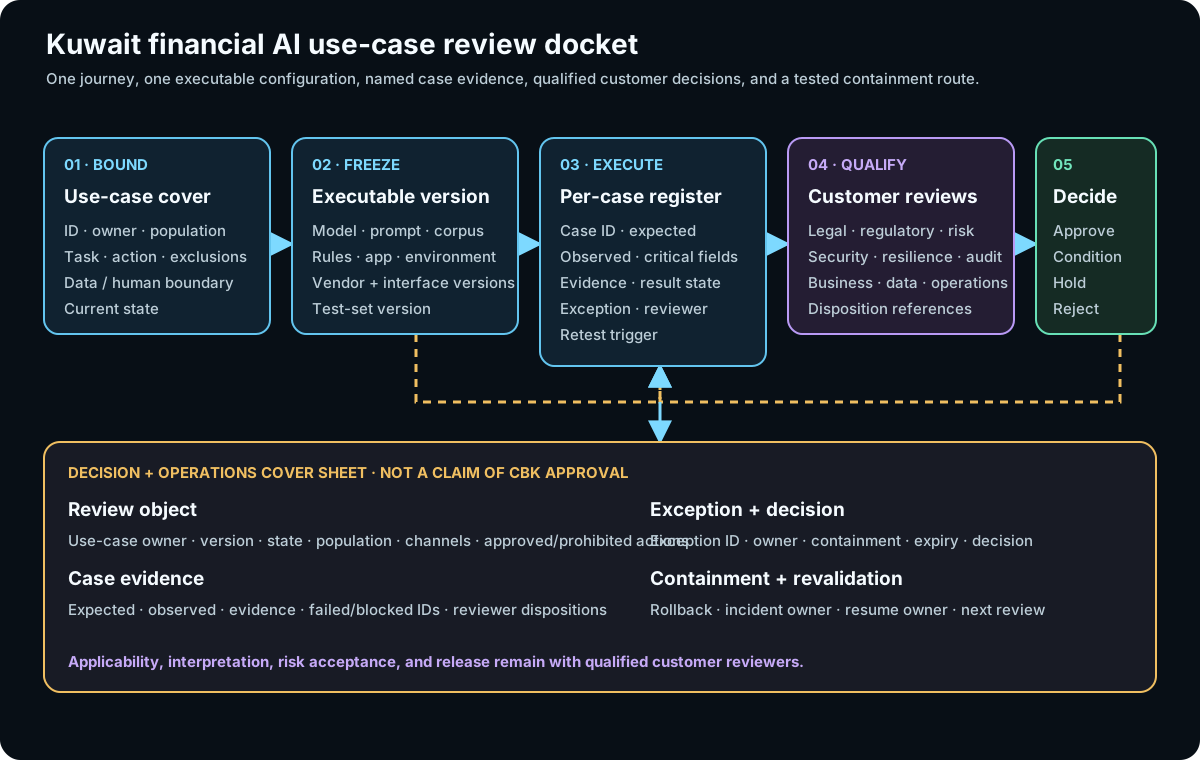
A model can answer a benchmark correctly and still fail the financial journey around it. It may use an outdated product rule, expose information to the wrong operator, change its recommendation after an undocumented prompt edit, or leave a customer without a workable escalation path. A release report that contains only average accuracy cannot tell a bank or fintech team which version was tested, what happened in a consequential case, who accepted an exception, or how the feature will be contained.
The appropriate review object is one AI-enabled use-case version: a bounded task, customer segment, channel, data flow, model and configuration, human role, decision consequence, and operating path. Engineering can produce reproducible tests and control evidence for that object. It cannot decide which Kuwait banking rules apply, interpret a Central Bank of Kuwait document, accept legal or conduct risk, or announce regulatory approval.
The official CBK Innovation Hub overview names AI, digitalization, information security, fintech, and testing as innovation themes. The Wolooj Framework Document visibly describes staged, case-specific testing and technical, safety, operational, reporting, and customer-risk considerations. The Cyber and Operational Resilience Framework page provides another official review reference. These pages explain why disciplined evidence matters; they do not establish participation, permission, approval, compliance, or a reusable checklist for every financial institution.
Open a docket before opening model access
Assign the use case a stable ID and version. State the customer problem in operational terms: assist an analyst in locating approved policy text, classify an inbound request for routing, summarize a recorded interaction for review, identify a suspicious pattern for investigation, or draft a response that a qualified employee must approve. Name the final action and the person or system authorized to take it.
The scope should identify users, customers affected, channels, languages, source systems, output recipients, financial or service decisions touched, and explicit exclusions. “Customer support copilot” is not enough. A reviewable object might be “agent-only draft for one enquiry category, using these approved sources, with no autonomous account change, offer, eligibility result, complaint disposition, or customer send.”
Record the data journey separately from the prompt. List fields received, source authority, transformations, retrieval indexes, model endpoint, logs, feedback stores, human queues, support access, exports, backups, and retention instructions supplied by the customer. A vendor diagram is not evidence that these paths match the deployed system.
Freeze every executable dependency
A model name does not identify a tested configuration. The docket should bind a model or service version, system prompt, task prompt, retrieval configuration, source-corpus snapshot, policy rules, feature code, output parser, safety configuration, interface contracts, and test-set version. For managed services whose internal build cannot be pinned, record the provider identifier and observed execution date, then define the regression trigger the customer accepts.
Source material needs authority and withdrawal states. A document can be approved, superseded, disputed, expired, or withdrawn. An answer generated from an old but still indexed document is not rescued by model fluency. Test replacement and withdrawal through search, retrieval, generation, caches, and user-visible citations.
Changes enter the same review path. Prompt edits, model upgrades, new fields, additional languages, new customer populations, vendor changes, lower human-review rates, expanded actions, or altered retention should produce an impact decision. A ticket saying “minor model improvement” should not bypass evidence when the journey or risk could change.
Text equivalent: AI use-case review docket
The image is a summary of the following operational record. The Markdown version is the authoritative text alternative for review and adaptation.
| Docket section | Fields that must be completed | Decision use |
|---|---|---|
| Cover | Use-case ID and version, business owner, technical owner, review coordinator, state, scope, exclusions, customer population, channel, and release candidate | Establishes the exact journey under review |
| Configuration | Model/provider identifier, prompt version, source-corpus version, retrieval/rule version, application build, environment, vendor dependencies, and test-set version | Reproduces the configuration that generated the observations |
| Case result | Case ID, expected behavior, observed behavior, critical fields, evidence link, result state, reviewer, and execution time | Prevents averages from hiding consequential failures |
| Risk disposition | Legal, regulatory, conduct, model-risk, data, cybersecurity, resilience, audit, accessibility, language, and operations review references supplied by qualified customer reviewers | Keeps interpretation and acceptance with accountable specialists |
| Exception | Exception ID, affected case and scope, rationale, containment, owner, expiry, retest trigger, and unresolved risk | Makes conditional release bounded and time-limited |
| Decision | approve, approve-with-conditions, hold, or reject; decision owner; date; conditions; approved population; and prohibited actions | Records a customer decision, never a claim of CBK approval |
| Operation | Monitoring signals, alert owner, human escalation, disable action, rollback version, incident owner, resumption owner, and next-review trigger | Connects release evidence to containment and revalidation |
| Required cover fields | Owner, version, state, expected, observed, evidence, exception, and decision | A missing observation or blocked test remains visible rather than becoming a pass |
Build cases around consequence, not conversational polish
The test register should include ordinary success, edge conditions, disallowed requests, missing data, conflicting sources, stale sources, revoked access, service timeouts, malformed model output, customer correction, and human escalation. Each case gets an expected business-safe outcome before execution. “Helpful answer” is too vague; specify whether the feature should draft, refuse, request information, route, warn, or leave the decision untouched.
Measure the field or action that matters. For a routing assistant, the consequential result may be queue, priority, and required review—not wording similarity. For document extraction, it may be customer identifier, amount, currency, date, and source-page locator. For an investigation aid, it may be whether evidence is surfaced without converting a signal into an unsupported allegation. Qualified business and risk owners choose tolerances based on use and consequence; this article supplies no universal threshold.
Arabic-English behavior should be segmented if the journey uses both languages. Test each expected direction, mixed-language inputs, names, numbers, transliteration, domain terms, right-to-left presentation, and escalation wording with approved material and appropriate reviewers. A successful English slice is not evidence for Arabic output, and a public innovation page is not a model-quality benchmark.
Keep advice, automation, and decision authority distinct
The user interface must show what the AI did and what the human is expected to decide. A draft should not be displayed as an authorized account fact. A risk signal should not become an adverse action without the customer’s approved process. If an employee can override output, capture the reason and outcome in a controlled form rather than an unrestricted comment that creates another sensitive dataset.
For customer-facing journeys, test notices and confirmations provided by qualified customer owners, correction, opt-out or alternate channel where required by the customer, and escalation that preserves the confirmed state. Engineering can implement these paths. Legal, regulatory, fair-treatment, disclosure, and customer-communication sufficiency remain decisions for qualified customer reviewers.
Human review is not effective merely because a button exists. Observe whether the reviewer receives source evidence, uncertainty, prior actions, conflicts, and prohibited operations; whether workloads are realistic; and whether the role has authority and time to intervene. Track automation bias indicators through an approved research and monitoring plan rather than assuming a human will catch every error.
Review data, vendor, and security boundaries together
The docket should identify which data leaves each trust boundary, the purpose instruction supplied by the customer, identity used, authorization check, encryption and key arrangement, storage or logging behavior, support-access path, deletion mechanism, backup treatment, and evidence source. Hosting and transfer conclusions cannot be inferred from a cloud region label. Qualified customer legal, privacy, cybersecurity, procurement, vendor-risk, and sector teams decide requirements and acceptance for the actual service.
Vendor due diligence and technical testing answer different questions. Contractual documents may describe commitments, while runtime evidence shows observed calls, denied paths, failures, and retained artifacts. Keep both references. Test credential revocation, timeout, retry, rate limit, duplicate request, malformed response, provider unavailability, and fallback. Ensure a fallback does not silently send broader data or switch to an unreviewed model.
The CBK cyber and operational resilience page is a source to place before the relevant reviewers, not a sentence that an engineer can translate into certification. Those reviewers should record applicability, selected controls, evidence expectations, exceptions, and acceptance in customer-controlled records. The article does not determine any of them.
Sign a bounded decision and prepare containment
A release meeting should reconcile every case total, failed or blocked case ID, accepted exception, reviewer disposition, condition, and excluded population. Approve-with-conditions must point to precise scope, an owner, expiry, and retest. If a required reviewer has not decided, the docket state is hold; silence is not acceptance.
Operational monitoring should map to the reviewed hazards: unauthorized access attempts, source-withdrawal failures, output-parser failures, human overrides, escalation backlog, vendor errors, drift in case slices, configuration changes, and unexpected action rates. Set thresholds through the customer’s risk process. Link every alert to an owner and containment action.
Rollback may mean disabling one use case, returning to a previous prompt/model/application bundle, removing a source, restoring mandatory human approval, isolating a vendor, or reverting to the pre-AI workflow. Exercise the route and record the observed result. Name who can contain, who investigates, who decides customer or regulator communication, and who authorizes resumption. Communication and notification conclusions remain outside engineering authority.
The final record is modest by design: a named customer decision for one version and population, with conditions and unresolved issues visible. It is not evidence of Wolooj participation, sandbox status, regulatory acceptance, or CBK approval. That smaller claim is more useful because another reviewer can reproduce it, challenge it, and know when it expires.
Annotated primary sources
What the public material supports—and what it does not
These official pages provide bounded public context. They do not prescribe this design, decide a customer’s obligations, or establish any LangData affiliation or conformity.
-
1.Central Bank of Kuwait — Innovation Hub Wolooj overview
Supports: The official overview describes an innovation environment involving artificial intelligence, digitalization, information security, fintech, and testing of developed products and services.
Boundary: It does not show that LangData or any customer participates, has been admitted, is supervised through the hub, has obtained CBK approval, or satisfies any banking requirement.
-
2.Central Bank of Kuwait — Innovation Hub Wolooj Framework Document
Supports: The official framework visibly discusses staged applications, case-specific testing scope, technical, safety and operational planning, safeguards, progress reports, customer-risk communication, and test results.
Boundary: This article neither interprets the framework nor claims sandbox admission, testing authorization, graduation, regulatory acceptance, CBK approval, or that its review docket reproduces CBK criteria.
-
3.Central Bank of Kuwait — Cyber and Operational Resilience Framework
Supports: The official CBK page identifies a named cyber and operational resilience framework that can be placed in the source pack for qualified financial-sector review.
Boundary: Applicability, scope, current requirements, interpretation, sufficiency, evidence expectations, and conformity conclusions remain with the customer's qualified legal, regulatory, risk, cybersecurity, audit, and sector reviewers.
Review the operating boundary before choosing the stack.
Bring one workflow, its approved source inventory, and the people who own authorization, review, and incidents.
Discuss the architecture review