Topic review
From use case to operated service: an Oman AI architecture review
An Oman-focused architecture review for mapping dependency contracts, coupled failures, degraded behavior, evidence, rollback, ownership, and change triggers around one AI-enabled workflow.
- Published by
- LangData Editorial, Editorial and architecture team
- Review owner
- Sourav Chandra, Co-Founder, LangData · Approved
- Published
- Updated
Swipe or scroll horizontally to inspect the full diagram.
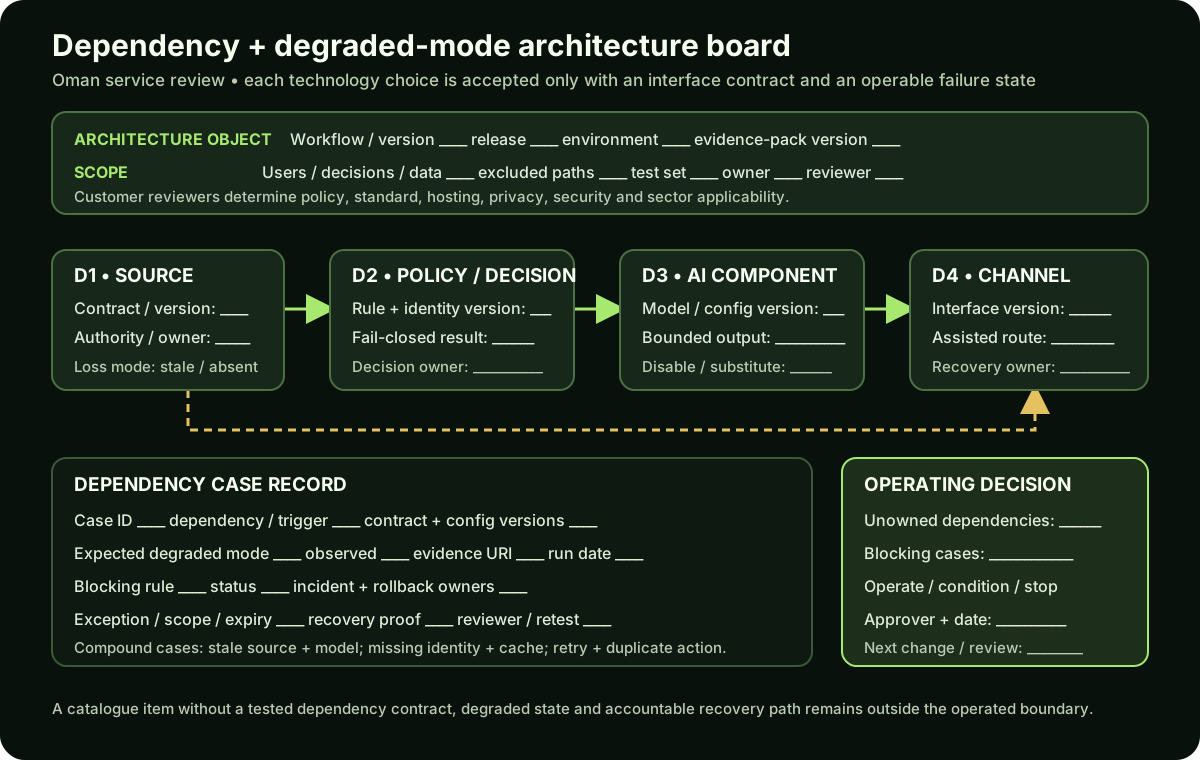
“Advanced technologies” is a catalogue label, not an architecture. A team can name an AI model, vector store, cloud service, automation tool, digital identity integration, and analytics layer without explaining how a user reaches an authoritative result—or what happens when two healthy components disagree. The missing design is not another product box. It is the set of dependency contracts, degraded states, decision authorities, and recovery evidence that make one workflow operable.
Oman’s MTCIT Artificial Intelligence sector page gives public context for a national AI and advanced digital technologies program. The Digital Transformation sector and National Digital Economy Program provide separate public framing for digital services, governance, data and analytics. Official pages for the safe and ethical use of AI policy and a cloud and hosting standard are review inputs with their own scope and interpretation boundaries. They do not convert a component list into an accepted service design.
This article uses a different architecture test: a technology belongs inside the operated boundary only when its input and output contract, owner, failure behavior, evidence, isolation or rollback action, and change trigger have been reviewed for the workflow version. The review follows dependency consequences instead of arranging products by novelty.
Start with the decision the workflow is allowed to influence
Define the user task, authoritative source of truth, and permitted effect. An AI component may locate information, extract a field, classify a case, draft text, recommend an option, or invoke a tool. Those roles carry different consequences. Record whether a person confirms the output, whether a business rule constrains it, and which system commits the final state.
Give the architecture object a workflow ID, version, release, environment, and evidence-pack version. State included users, sources, document families, actions, channels, and integrations. Write exclusions. If the review covered recommendation but not automatic execution, the tool action remains outside scope even when the code path exists.
Freeze the test set and all relevant versions: source snapshot, parser or OCR, metadata, retrieval, model, prompt or orchestration, policy, interface contract, workflow code, logging configuration, and operator runbook. The purpose is traceability, not a preference for one stack.
Replace arrows with dependency contracts
An arrow in a diagram should correspond to a contract that can be tested. For each dependency, record owner, authority, interface and schema version, identity, permitted data, timeout, retry and idempotency behavior, freshness, error states, telemetry, retention instruction, and change notification. Link to the customer-approved policy or design input that governs it.
A source contract should say which version is authoritative for the task, how withdrawal propagates, and what the workflow does when freshness or provenance cannot be established. A policy-decision contract should specify required identity or attributes, fail-closed behavior, trace fields, and owner of rule changes. An AI component contract should define bounded input and output, configuration, uncertainty handling, prohibited action, disablement path, and evidence. A service-channel contract should preserve user and business state through validation, retry, handoff, and recovery.
Third-party endpoints and internal platforms receive the same treatment. A supplier status page is not evidence that the workflow handled an outage. A connector health check is not proof that its data is current, correctly authorized, or reconciled with the system of record.
Trace coupling before selecting a fallback
Dependencies rarely fail alone. A stale source can coexist with a responsive retrieval service. An expired identity can encounter a cached answer. A model timeout can occur after a tool completed its action. A channel retry can duplicate a write while all component dashboards remain green. Architecture review should include these coupled conditions because their visible result can look successful.
Create a coupling map from each dependency to decisions, stores, caches, user messages, audit events, and recovery steps. Ask which derived representations survive when the upstream item changes. If a policy role is revoked, which caches, active sessions, queued jobs, search results, or operator views can still use it? If a source is withdrawn, where do chunks, summaries, citations and exports remain?
Then define failure containment. The service may quarantine a source, block an action, use a verified snapshot, turn generation off, enter read-only mode, route to assisted handling, or stop. A fallback is acceptable only when customer owners approve its data, authority, user meaning, and operating burden. Substituting another model does not solve a missing authoritative source or an uncertain transaction.
Design degraded behavior as part of the architecture
For every essential dependency, write a degraded-mode case with a stable ID. State the failed or changed condition, expected user message, permitted action, prohibited output, evidence event, incident owner, containment, recovery check, and resumption authority. Include a maximum reviewed condition or another blocking rule set by the relevant customer owners.
A source outage may permit answers from a dated verified snapshot for one low-consequence journey, while another task must stop. A policy-service outage may require denial because identity or purpose cannot be resolved. An AI endpoint outage may allow an approved deterministic search or manual route. A business interface in uncertain state may require reconciliation before the user can retry.
Test the state, do not merely document it. Capture the injected condition, executed configuration, expected result, observed result, logs and traces, operator action, reviewer, and date. If the team cannot create the condition safely, record the case as blocked and define how evidence will be obtained. Simulation can be useful, but the record should say which parts were simulated and which were observed through the integrated path.
Make the AI component replaceable without hiding its effect
A replaceable boundary needs more than a common API shape. Different models and retrieval components can interpret prompts, tools, citations, refusal, structured output, Arabic-English content, and truncation differently. The contract should state the semantic behavior the workflow expects and the cases that must be rerun after substitution.
Separate component output from business acceptance. Validate schema before use. Treat unknown fields, malformed structures, unresolvable citations, unsupported content, and out-of-scope tool requests as explicit conditions. Record which outputs require human review and how the reviewer sees the source and authoritative system state.
Do not publish a generic quality threshold. Build cases from customer-approved tasks and material, with native-language and domain review where required. A component can pass extraction while failing retrieval, or return a well-formed response with the wrong business meaning. Keep these dispositions separate so a replacement targets the actual failure.
Bind architecture changes to affected evidence
Every contract should declare review triggers. Source schema, classification, owner, or authority can change. A policy can be reinterpreted by qualified customer reviewers. An endpoint can revise its data handling or response shape. A model, prompt, parser, retrieval setting, interface, cache, queue, identity claim, or operator role can be updated.
Maintain a dependency-to-case index. When a version changes, it should identify the affected success, denial, degradation, rollback, and recovery cases. The release record remains conditional until those rows are current. An architecture decision record that only explains the initial choice is incomplete; it should also describe replacement conditions and how the service returns to review.
Evidence and logs need customer-approved access and retention. Preserve correlation IDs, configuration versions, source and policy decisions, system states, administrative actions, and rollback events without copying sensitive content into unrestricted observability. Engineering produces facts; customer legal, privacy, security, records, procurement, accessibility, AI-governance, and sector teams determine applicable treatment.
Keep Oman policy and hosting questions in qualified review
The MTCIT AI and policy pages make responsible use a visible official topic, but this review does not interpret the policy or claim conformity. The cloud and hosting page identifies a standard with stated government-agency context and age; it must not be generalized to every Oman organization or workload. Architecture can present customer-selected options such as a customer cloud environment, dedicated tenancy, private deployment, or on-premises pattern. Qualified customer reviewers decide applicability and acceptance.
Record those decisions as versioned external inputs with decision owner, date, affected components, and review trigger. Do not turn an official title into an engineering requirement without the current document-level and qualified review needed for that specific workflow.
Complete text equivalent: dependency and degraded-mode board
The following tables reproduce every decision field in the SVG. They are suitable for a controlled architecture record when the image is not available.
| Architecture cover | Required entry |
|---|---|
| Review object | Workflow ID and version, release ID, environment, evidence-pack version and decision date |
| Scope | Users, tasks, decisions, data, sources, channels, actions and integrations included; explicit exclusions |
| Frozen setup | Test set; source, parser, retrieval, model, prompt, policy, workflow, interface, logging and runbook versions |
| Accountable roles | Workflow, source, policy, AI component, interface, operations, incident, review, rollback and resumption owners |
| Qualified inputs | Customer-approved legal, privacy, security, procurement, records, hosting, accessibility, AI-governance and sector decision references where applicable |
| Dependency record | Contract fields | Degraded-state fields |
|---|---|---|
| D1 — source | Owner and authority, snapshot or schema version, provenance, freshness, withdrawal, authorization and downstream representations | Missing, stale, conflicting and withdrawn cases; allowed snapshot or stop rule; quarantine; cache/index reconciliation; recovery proof |
| D2 — policy or decision | Identity and rule version, required attributes, decision response, trace, owner and change notification | Missing, stale or unavailable policy cases; fail-closed result; session/cache invalidation; decision-owner and resumption authority |
| D3 — AI component | Model and configuration, bounded input/output, tool allowance, validation, evidence, data handling, disablement and substitution | Timeout, malformed output, unsupported content, citation failure and prohibited action; isolate/disable/manual route; component retest |
| D4 — service channel and business interface | Contract version, authoritative state, validation, timeout, retry, idempotency, user message, handoff and audit event | Rejection, uncertain completion, duplicate request, queue loss and notification failure; reconcile/assist/stop; user-state and recovery evidence |
| Per-case field | Required entry |
|---|---|
| Identity | Stable case ID, affected dependency or coupled dependencies, review object, test-material reference and trigger condition |
| Executed versions | Dependency contract, source, policy, model, prompt, workflow, interface and environment versions |
| Expected behavior | Permitted service state, user message, authoritative state, prohibited result, evidence event and escalation route |
| Observed behavior | Actual user and system states, trace or evidence URI, executor and date, reviewer and review date |
| Decision rule | Time, authority, safety, quality or state blocker; pass, fail or blocked; affected scope |
| Containment and recovery | Isolation or rollback, reconciliation, incident owner, recovery test, operator acceptance and resumption authority |
| Exception and revalidation | Exception ID, rationale, permitted scope, owner, expiry, retest trigger and next review |
| Final architecture decision | Required entry |
|---|---|
| Reconciliation | Unowned dependencies, failed and blocked cases, compound failures, open exceptions and expired evidence |
| Operating boundary | Dependency versions accepted, degraded states permitted, routes excluded, rollback tested and recovery authority assigned |
| Decision | operate, operate-with-conditions or stop; approver, decision owner, release ID and date |
| Change trigger | Source, policy, model, prompt, interface, hosting, ownership or incident events that return affected cases to review |
Judge the operated boundary, not the catalogue
If a dependency has no owner, a change cannot be traced to affected cases, or a failure leaves user or business state uncertain, the architecture is not accepted for that path. A blocked degradation test remains visible. A condition must limit scope, name an owner, cite evidence, and expire. Rollback must include data and state reconciliation, not only a component version change.
This yields a modest but defensible decision: one Oman-focused workflow version can be operated within the recorded boundary and conditions. It does not certify an AI technology, settle policy or hosting questions, or imply an official relationship. Its value comes from exposing exactly where the service depends on data, decisions, components and people—and proving what they do when those dependencies change or fail together.
Annotated primary sources
What the public material supports—and what it does not
These official pages provide bounded public context. They do not prescribe this design, decide a customer’s obligations, or establish any LangData affiliation or conformity.
-
1.MTCIT — Artificial Intelligence sector
Supports: Official Oman context for the National Program for Artificial Intelligence and Advanced Digital Technologies, adoption, capability, infrastructure, research, and human-centric governance themes.
Boundary: It does not select components, authorize access, verify an implementation, prescribe this dependency method, establish model quality, or prove LangData program participation.
-
2.MTCIT — General Policy for the Safe and Ethical Use of Artificial Intelligence Systems
Supports: An official policy reference whose visible page frames safe, responsible, effective, and ethical AI adoption as a subject for qualified review.
Boundary: This article does not interpret detailed duties, decide applicability, claim policy conformity, or treat engineering evidence as legal, ethical, regulatory, or official acceptance.
-
3.MTCIT — Digital Transformation sector
Supports: Official context for Oman government digital transformation, the Tahawul program, a roadmap, and execution-governance framing.
Boundary: The page does not establish that a specific workflow uses a listed architecture, prove current service outcomes, grant government-system access, or show LangData involvement.
-
4.MTCIT — National Digital Economy Program
Supports: Official program context spanning digital government, society, business, infrastructure, policy and governance, skills, innovation, services, data, and analytics.
Boundary: Program themes and targets do not define customer requirements, approve this architecture, demonstrate implementation, or substantiate performance and outcome claims.
-
5.MTCIT — Cloud and Hosting Services Standard
Supports: An official page identifying an older government-agency cloud standard and visible topics such as deployment, providers, security, privacy, and data sovereignty.
Boundary: The stated scope and age matter; the page is a review trigger, not a universal Oman hosting rule, current applicability decision, legal interpretation, or evidence that an architecture satisfies the standard.
Review the operating boundary before choosing the stack.
Bring one workflow, its approved source inventory, and the people who own authorization, review, and incidents.
Discuss the architecture review