Topic review
Operating an Oman data-publication pipeline: provenance, quality, and withdrawal
A control-room design for Oman open and statistical data that quarantines uncertain inputs, reconciles public channels, and proves refresh or withdrawal through observed evidence.
- Published by
- LangData Editorial, Editorial and architecture team
- Review owner
- Sourav Chandra, Co-Founder, LangData · Approved
- Published
- Updated
Swipe or scroll horizontally to inspect the full diagram.
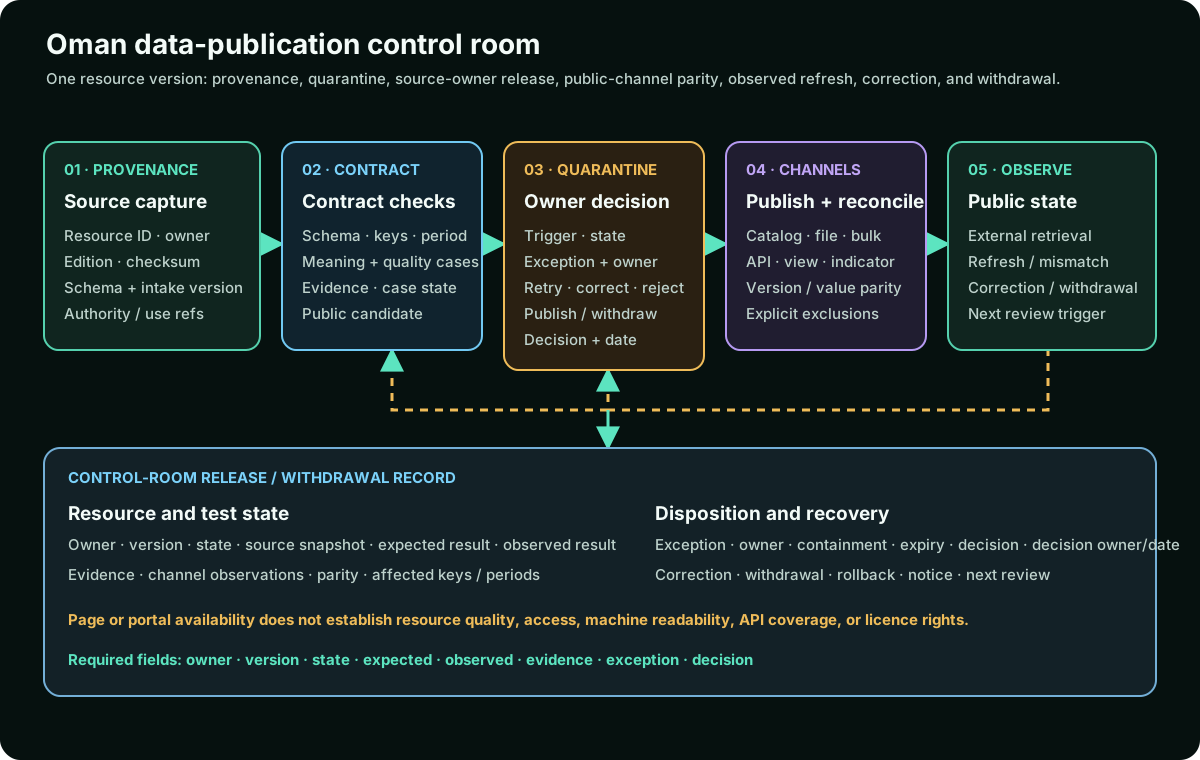
A publication job can complete successfully while the public data product fails. The job may have read a stale source, accepted a silent schema change, generated a new file but left an older API response, omitted a licence-decision reference, or republished a resource that an owner meant to withdraw. A green scheduler icon measures execution, not authority or public truth.
An Oman data-publication pipeline should operate like a control room. It captures provenance before transformation, tests an owner-approved contract, diverts uncertainty to quarantine, requires an explicit source-owner release, observes each public channel, and keeps correction and withdrawal on the same path as publication. Every transition has an expected result, an observed result, evidence, an exception route, and a decision owner.
The MTCIT Open Data page visibly discusses documentation, machine-readable access, bulk download, and APIs as open-data concepts. The Oman National Data Portal presents discovery, visualizations, indicators, policy, terms, and government-licence references. The National Centre for Statistics and Information provides statistical publication context, and an MTCIT data-governance circular summary names governance-office, assessment, management-practice, and quality themes.
These reachable pages provide specific Oman context. None proves the condition, interface, continuity, rights, or suitability of a particular dataset. Those properties must be checked at resource level.
Capture provenance before the first transformation
Create a resource record before automation. Include publisher and source owner, source-system or page identifier, resource URL, intended edition or period, retrieval method, authority state, expected availability supplied by the owner, schema expectation, classification and disclosure references, licence-decision reference, and accountable steward. Assign a resource ID that follows the data through files, APIs, transformations, catalog entries, and incidents.
At intake, preserve retrieval time, effective URL, response state, content type, checksum, size, source-provided version or date, and an immutable evidence reference under approved storage rules. For an API, include request parameters, endpoint version, pagination behavior, and authentication context without exposing credentials. For a file, record archive members, encoding, delimiter, sheet names, and parser version.
Do not treat an absent version label as permission to invent one. Use an observed snapshot identifier and raise an owner question. Likewise, receiving HTTP 200 proves only that bytes arrived. It does not prove that the bytes are the intended dataset, current, complete, machine-readable, or authorized for the proposed reuse.
Quarantine uncertainty instead of normalizing it away
The quarantine gate should catch technical failure and unresolved meaning. Triggers include source not found, unexpected redirect, access denial, invalid content, changed schema, new category, duplicate key, changed unit, unexplained historical revision, missing period, failed licence or disclosure reference, owner unknown, and quality test blocked.
Each quarantine event gets a state and owner. technical-retry may handle a transient connection. source-review asks whether a new edition or location is authoritative. domain-review examines definitions and revisions. policy-review routes disclosure, licensing, privacy, records, or sector questions to qualified customer reviewers. reject prevents publication. The engineering team should not silently coerce changed data until tests pass; normalization can hide the very change that consumers need to understand.
Keep the last approved public release separate from the candidate. The customer decides whether users see the previous release with a visible status, a temporary-unavailable state, or another response. Never imply that “serve stale” is universally appropriate.
Text equivalent: publication control-room record
The operational SVG is reproduced as structured text below. The table includes every field needed to follow the flow without visual access.
| Control-room station | Required fields | Exit condition |
|---|---|---|
| Source and provenance | Resource ID, source owner, steward, source location, edition/period, expected availability, retrieval time, checksum, schema version, authority state, and evidence link | The candidate can be reproduced and its owner identified |
| Contract tests | Rule/case ID, expected schema and semantic result, observed result, affected keys or periods, test version, severity from the owner, and evidence | All required tests have an observed disposition |
| Quarantine | State, trigger, exception ID, responsible owner, requested decision, containment, retry or review date, and unresolved consequence | A named owner chooses retry, correct, accept condition, or reject |
| Release decision | Candidate version, scope, excluded channels, source-owner approval reference, qualified-review references, decision, decision owner, and date | publish, publish-with-condition, hold, or withdraw is recorded |
| Public channels | Expected and observed catalog page, file, bulk route, API, visualization, indicator, and metadata versions; retrieval and parity evidence | Every claimed representation is tested or explicitly marked unavailable/not in scope |
| Operation | Refresh observation, lag or failure state, alert owner, consumer notice, correction action, withdrawal propagation, rollback, and next-review trigger | Public state matches the register and open failures have owners |
| Mandatory cover fields | Owner, version, state, expected, observed, evidence, exception, and decision | Intent and observation remain separate throughout the lifecycle |
Test data meaning as well as structure
Schema validation catches missing columns and type changes, but publication quality also depends on meaning. Use owner-approved checks for key uniqueness, period continuity, category membership, valid ranges, units, geographic or organizational coverage, revision flags, and aggregate reconciliations. Store observed values or counts beside the expectation. A rule called quality_passed without underlying results is not review evidence.
Statistical series require edition awareness. A later publication may revise prior periods, change a base, update classifications, or correct records. Preserve source notes and link them to affected outputs, but ask a qualified domain reviewer to decide comparability. Engineering can show a diff and downstream impact; it should not explain the statistical meaning beyond inspected official material and owner input.
Test approved difficult cases with synthetic or non-sensitive fixtures: malformed rows, Arabic and English labels where present, alternate numeral and date forms, empty partitions, duplicate uploads, partial API pages, and interrupted extraction. The relevant cases depend on the source; no national portal page supplies a universal test set.
Reconcile catalog, file, API, and visualization
A release should publish one resource identity across channels. Where a catalog page, download, API, chart, or indicator represents the same underlying release, compare version or snapshot, schema, period, units, row/key aggregates, and selected values. A visualization may intentionally transform the data; its metadata should say so and link to the source release and transformation version.
Fetch public representations from outside the internal pipeline boundary. Check response state, redirects, content type, encoding, machine parsing, documentation, and an owner-approved sample. Document authentication or access constraints exactly. The existence of API language on the MTCIT page, or navigation on a portal, cannot establish an endpoint for a particular resource.
Access and licensing are separate checks. A file that downloads without authentication is not necessarily unrestricted for reuse. A government-licence link on a portal does not settle rights for third-party fields, attachments, logos, boundaries, or a changed release. Require a current resource-specific decision from the source owner and qualified policy or legal reviewer; expose the approved notice and attribution without interpreting it.
Observe refresh as a public event
Expected refresh belongs in the source contract with its provenance: publisher statement, owner instruction, or customer-defined operating target. Record expected period and tolerance, then observed source availability, pipeline intake, owner decision, public release, and channel propagation. These timestamps allow diagnosis without claiming that the publisher promised a service level.
Distinguish failure stages. The source may not yet exist; retrieval may fail; validation may quarantine it; owner review may be pending; a channel may fail to publish; or an external cache may remain old. Each state needs a different owner and user message. A single “late” flag turns governance and delivery questions into one unhelpful alert.
Monitoring should also detect unexpected early replacement, checksum change without version change, schema drift, failed public parse, channel mismatch, and expired exception. Alerts point to the resource ID, current state, last approved version, evidence, and allowed operator action.
Exercise correction and withdrawal end to end
Correction creates a linked replacement. Record the defect, affected scope, consumer impact, owner decision, candidate version, changed values or schema, tests, and public note. Invalidate controlled caches and derived products, then observe the result through the public routes. Preserve the superseded identity where approved so prior analysis can be reproduced.
Withdrawal is a first-class release decision. Stop scheduled republishing, remove or disable in-scope files and endpoints, change catalog state, invalidate visualizations and caches, notify registered consumers, and verify what a public request receives. Keep decision evidence under approved access and records instructions. A rollback of infrastructure must not republish a withdrawn resource, so test state restoration alongside backup recovery.
Run a periodic canary with a synthetic resource: publish, refresh, introduce a contract break, quarantine, approve a correction, and withdraw. Record expected versus observed results and operator actions. The exercise reveals whether owners can actually make and enforce decisions without waiting for a live-data incident.
Close only on evidence
A release decision should identify the exact resource version, tests, failed or blocked cases, qualified-review inputs, exception IDs, channels included, monitoring owner, and next review. Publish-with-condition requires bounded scope, an owner, expiry, and retest. A source-owner or qualified-review decision that is still pending leaves the candidate on hold.
The resulting claim is deliberately narrow: this resource version was obtained from a named source, passed specified owner-approved checks, received a recorded release decision, was observed through listed channels, and has a tested correction or withdrawal path. It does not say that every Oman dataset is fresh, accurate, accessible, machine-readable, or licensed for every reuse. That distinction is the foundation of credible data operations.
Annotated primary sources
What the public material supports—and what it does not
These official pages provide bounded public context. They do not prescribe this design, decide a customer’s obligations, or establish any LangData affiliation or conformity.
-
Supports: The official MTCIT page visibly presents ministry open-data material and describes documentation, machine-readable access, bulk download, and APIs as open-data concepts.
Boundary: It does not prove that every listed resource is current, complete, technically machine-readable, available in bulk or by API, unrestricted for reuse, or suitable for a particular customer purpose.
-
Supports: The official portal states that it provides access to datasets from different entities and visibly presents topic discovery, visualizations, indicators, policy, terms, and government-licence references.
Boundary: Portal availability does not establish dataset accuracy, freshness, completeness, interface coverage, service levels, access continuity, or licensing rights for an individual resource.
-
3.Oman National Centre for Statistics and Information
Supports: The official NCSI portal presents statistical publications and links to the national data portal and other statistical portals as institutional publication context.
Boundary: This does not make a publication correct for a proposed metric, guarantee edition comparability or update timing, authorize reuse, or show that LangData has non-public access.
-
Supports: The official page summarizes government data-governance offices, assessment tools, standardized management practices, and data-quality themes.
Boundary: The summary does not determine legal scope, prescribe this pipeline, establish current detailed requirements, or prove conformity; qualified customer reviewers must inspect applicable primary material.
Review the operating boundary before choosing the stack.
Bring one workflow, its approved source inventory, and the people who own authorization, review, and incidents.
Discuss the architecture review