Topic review
Releasing a Qatar AI service: evidence, escalation, and operating ownership
A Qatar-focused release review for proving that an AI-enabled service can detect unsafe states, contain them, hand them to accountable operators, and recover with inspectable evidence.
- Published by
- LangData Editorial, Editorial and architecture team
- Review owner
- Sourav Chandra, Co-Founder, LangData · Approved
- Published
- Updated
Swipe or scroll horizontally to inspect the full diagram.
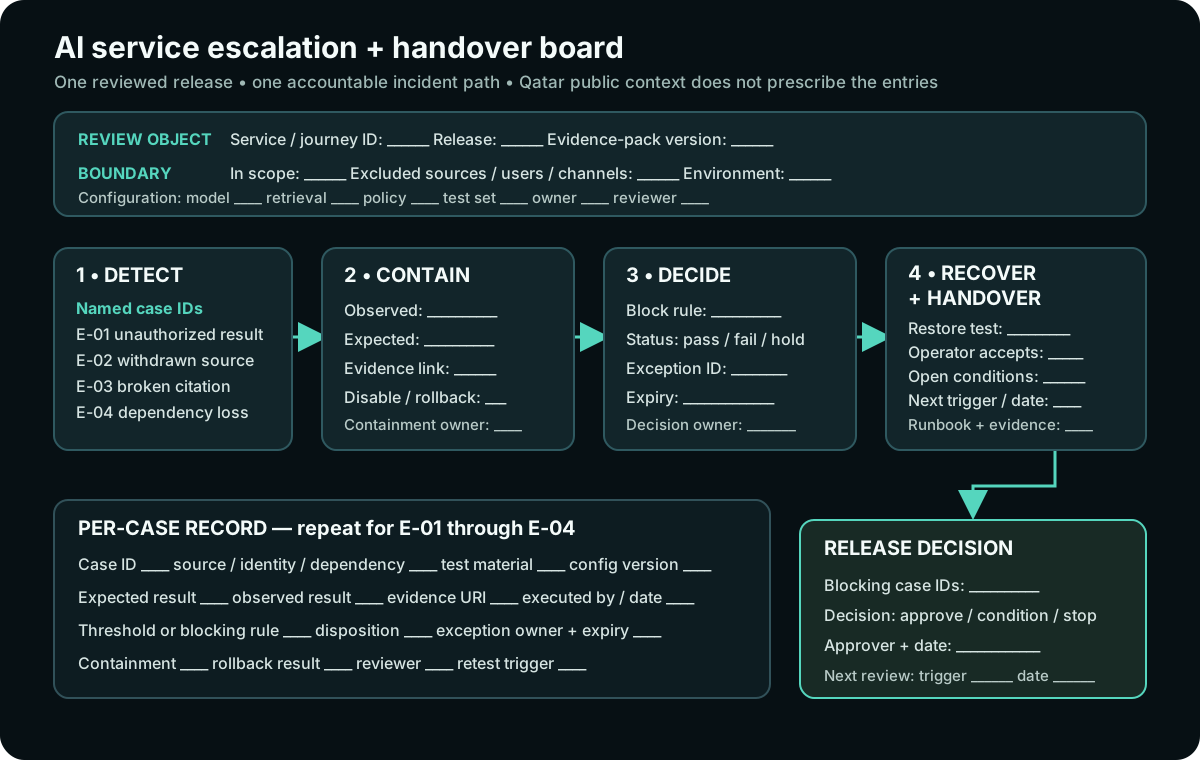
An AI demonstration can be persuasive while leaving the most important operating question unanswered: who takes control when the answer, source, identity check, integration, or cloud dependency behaves differently from the reviewed case? A release meeting should not end with a model score and a list of monitoring charts. It should end with named people accepting a bounded service, named incident cases, tested containment actions, and a handover record that an operator can use without reconstructing the project from slide decks.
That emphasis is particularly useful for a Qatar service boundary that may touch shared identity, data exchange, payment, notifications, a catalog, or a customer-selected cloud pattern. The official Hukoomi Digital Projects page records public descriptions of shared digital-project patterns, although direct access was intermittent during final review. The State of Qatar Open Data portal provides public catalog and reuse context, while its Open Data Policy page is a reference for qualified source, publication, reuse, and governance review rather than an interpretation supplied here. The CRA Cloud Policy page identifies subjects for cloud and stakeholder review. None of these pages chooses an AI stack, confirms the state of a particular integration, makes a dataset authoritative for a workflow, or endorses this review method.
The thesis of this review is narrower: a Qatar-focused AI service is not ready for release until its team can recognize a material fault, contain the affected boundary, preserve decision evidence, transfer control to an authorized owner, and prove recovery for the exact release under review. The result is an escalation contract, not a promise that incidents will never happen.
Name one service and its operating edge
Begin with a journey ID and version rather than “the assistant.” State the user action at the beginning, the authoritative outcome at the end, and every system that can change that outcome. A service that answers a question from approved material has a different edge from one that updates a case, initiates a payment, routes a request, or summarizes a record for an employee. The latter paths require transaction state, idempotency, reconciliation, and recovery evidence in addition to retrieval tests.
The boundary record should identify users and roles, entry channels, approved source inventories, identity and policy services, extraction and indexing components, model endpoints, business interfaces, caches, logs, human queues, and operator tools. Record exclusions. If one document family, user group, integration, language direction, or channel was not evaluated, it is outside the release even if the system can technically receive it.
Freeze configuration with the review object: source snapshot, extraction version, chunking and retrieval settings, prompt or orchestration version, model endpoint, policy configuration, interface contracts, test-set version, and environment. A later operator must be able to determine whether an incident occurred on the accepted configuration or after an unreviewed change.
Turn failure modes into stable escalation cases
An alert name is not an escalation case. Each case needs a stable ID, initiating condition, expected service response, prohibited outcome, evidence location, owner, and blocking rule. Start with failures that cross the service boundary rather than convenient infrastructure metrics.
E-01 — unauthorized result. Use two or more contrasting test identities and records. The expected result may be a denial, a bounded response from permitted material, or a handoff. The prohibited result is restricted content entering retrieval, generation, a cache, or an operator view. Evidence must connect identity and policy decisions to retrieved source IDs on one request trace.
E-02 — withdrawn or superseded source. Replace a controlled source version, invalidate affected representations, and then withdraw it. The observed record should cover the index, cached answers, citation targets, and any summary store. A successful ingestion log does not prove that old content stopped being available.
E-03 — broken or unsupported citation. Test an answer that should resolve to an authorized page or section, an answer with conflicting approved sources, and a question for which no approved support exists. The safe result should be specified before execution. A plausible answer without resolvable support is a release failure when support is required by the workflow.
E-04 — dependency loss. Interrupt or simulate failure of identity, policy, source, index, model, business interface, and human queue dependencies one at a time. Then test coupled conditions, such as a healthy model with stale source state or a retry after an uncertain business action. The service should enter a named degraded, assisted, or stopped state instead of improvising success.
Additional cases belong in the same register when the workflow warrants them: extraction corruption, prompt injection in an approved source, duplicate writes, incorrect language routing, unsafe feedback reuse, logging failure, or an unavailable escalation queue. The list is selected by the actual journey and customer risk owners, not copied as a universal Qatar control set.
Separate detection from authority to contain
Detection evidence should describe the condition and its service consequence. A high refusal rate, for example, could reflect correct protection, broken retrieval, or an upstream outage. An operator needs traces that distinguish those explanations without gaining unrestricted access to source text or user content.
Containment authority must be explicit before release. One role may be allowed to quarantine a source; another may disable generation; another may revoke a connector; another may put a transactional journey into read-only mode. Record how to freeze ingestion, invalidate selected caches, block an identity segment, restore an index snapshot, route users to assisted service, or stop the entire boundary. Test access to these controls and the audit event they produce.
A containment action should be narrow enough to preserve safe service where possible and broad enough to stop the defined harm. That balance is a release decision. Engineering can expose options, but customer service, data, security, privacy, records, and sector owners decide which action is authorized for each event.
Make handover a transfer of decision state
A ticket containing a transcript is not a handover. The receiving operator needs the journey and release IDs, case ID, identity and authorization outcome, eligible source set, observed result, configuration versions, dependency state, containment already performed, evidence links, unresolved questions, and the next authorized action. Sensitive details remain in approved systems; the handover should point to them rather than duplicate them into an uncontrolled channel.
Define acknowledgement and rejection. An operator should be able to reject a handover that lacks authority, evidence, or sufficient context. That rejection is a service signal with its own owner. Track queue age and unresolved cases, but do not publish a generic time target. The acceptable interval depends on the service consequence, staffing model, and customer decision.
Recovery also needs authority. Restoring a component to health does not automatically permit traffic to resume. The case record should show containment closure, corrected configuration, relevant retest results, remaining conditions, rollback readiness, reviewer acceptance, and the person who authorized resumption.
Use evidence that survives the launch meeting
Every executed case should link to durable, access-controlled evidence: test input reference, expected result, relevant logs, source and policy decisions, observed output, screenshots where useful, incident or runbook record, executor, reviewer, and date. Store identifiers and approved references in the meeting record instead of copying sensitive test content.
Evidence has a lifetime. Source snapshots age, entitlement mappings change, interfaces are revised, owners leave, and test sets stop representing the journey. Record an expiry or event-based review trigger for each accepted exception and for the release as a whole. Changes to source authority, identity claims, extraction, retrieval, prompting, model endpoint, policy, business interface, logging, or escalation ownership should route the affected cases back to review.
Complete text equivalent: escalation and handover board
The following tables are the complete structured equivalent of the diagram. They can be used directly when the SVG is unavailable. Complete the cover once, then create one case row for every required incident and one final decision record.
| Cover field | Required entry |
|---|---|
| Review identity | Service or journey ID, release ID, evidence-pack version, environment, review date |
| Scope | Users, tasks, channels, approved sources and integrations included in the decision |
| Exclusions | Unevaluated document families, identities, language paths, channels, actions and dependencies |
| Executed versions | Source snapshot, test set, extraction, retrieval, prompt or orchestration, model, policy and interface versions |
| Accountability | Service owner, source owner, identity or policy owner, operator, incident owner, reviewer and decision authority |
| Change boundary | Changes that require case retest and the person responsible for starting re-review |
| Case ID | Condition to execute | Expected result | Observed result and evidence | Blocking rule | Containment and handover | Disposition |
|---|---|---|---|---|---|---|
| E-01 | Contrasting identities request allowed and restricted material; include revocation and cache isolation | Only authorized material can enter retrieval and generation; missing or stale policy state follows the recorded safe path | Record identity and policy versions, retrieved IDs, trace, executor, date and evidence URI | Any restricted material reaches retrieval, output, cache or unauthorized operator | Disable affected path, preserve trace, assign identity/security owner and receiving reviewer | pass, fail or blocked; exception ID, owner, permitted scope and expiry |
| E-02 | Replace and withdraw a canary source across index, citations, caches and summaries | Superseded or withdrawn content is unavailable in the reviewed current-information path | Record source versions, reconciliation result, timestamps, query evidence and URI | Old content remains available or evidence cannot cover an in-scope representation | Quarantine source, invalidate affected stores, notify source owner, state rollback | Status, reviewer, retest date and next source-change trigger |
| E-03 | Run supported, unsupported, conflicting and unresolvable-citation questions | Supported claims resolve to authorized source versions; missing or conflicting evidence follows the approved refusal or escalation | Record expected source IDs, observed locators, response, trace and review note | A required claim lacks resolvable authorized support or invents a successful result | Disable affected answer path or narrow sources; hand to domain owner | Status, exception, expiry, reviewer and correction owner |
| E-04 | Remove each required dependency and execute coupled failure or uncertain-retry cases | Service enters the named degraded, assisted or stopped state without false success or duplicate action | Record dependency and interface versions, injected condition, observed state, evidence and recovery test | Unknown state, unauthorized fallback, duplicate action or unavailable escalation remains | Isolate dependency, select manual route or stop boundary; name recovery and resumption authorities | Status, rollback result, open condition and retest trigger |
| Final decision field | Required entry |
|---|---|
| Reconciliation | Total cases, passed, failed and blocked counts; every blocking case ID; every accepted exception ID |
| Operating proof | Containment controls exercised, handover accepted, rollback result, runbook link and operator acknowledgement |
| Conditions | Permitted scope, rationale, accountable owner, evidence link, expiry and retest for each exception |
| Decision | approve, approve-with-conditions or stop; decision owner, approver, decision date and release ID |
| Revalidation | Next review date if time-based and event triggers such as source, policy, model, interface or ownership change |
The release rule is operational, not aspirational
Do not approve a required case because the team expects to add a runbook later. A case that could not be executed is blocked, not passed. An exception must narrow the released scope, identify its owner, link its rationale, and expire. If containment cannot be invoked by the assigned role, if the receiving queue cannot accept the handover, or if resumption authority is unknown, the service boundary is not operable for that event.
This discipline does not claim that one architecture applies across Qatar. It creates a reviewable decision for one customer-defined service and release. Official pages remain bounded public inputs. The durable evidence is the tested boundary, the case record, the named owners, and the recorded authority to contain, recover, and decide again when the service changes.
Annotated primary sources
What the public material supports—and what it does not
These official pages provide bounded public context. They do not prescribe this design, decide a customer’s obligations, or establish any LangData affiliation or conformity.
-
Supports: Official Qatar public context for shared digital-project patterns such as government data exchange, authentication, payment, integration, and shared services.
Boundary: Direct checks were intermittent: HTTP 200 earlier in the review and HTTP 403 on the final curl re-check. Some descriptions also relate to earlier strategy periods; the page does not prove current status, prescribe one architecture, grant access, or establish LangData involvement.
-
2.State of Qatar Open Data portal
Supports: Official public evidence that a Qatar catalog exposes dataset discovery, tools, visualizations, policy and license references, request paths, and reuse-oriented interfaces.
Boundary: Portal availability does not establish dataset authority, quality, freshness, completeness, API coverage, permission to use a resource, or suitability as an AI source.
-
3.State of Qatar Open Data Policy
Supports: An official policy reference that source, publication, reuse, and governance owners can place beside the technical source register for qualified review.
Boundary: This article does not interpret publication duties, disclosure, licensing, attribution, privacy treatment, applicability, or the legal effect of the policy for a customer workflow.
-
4.Communications Regulatory Authority — Cloud Policy
Supports: An official Qatar policy page that makes cloud, security, privacy, data protection, transparency, and digital inclusion relevant subjects for stakeholder review.
Boundary: It is not a universal hosting or residency rule, legal interpretation, architecture approval, compliance finding, procurement statement, or evidence that LangData meets an official requirement.
Review the operating boundary before choosing the stack.
Bring one workflow, its approved source inventory, and the people who own authorization, review, and incidents.
Discuss the architecture review