Topic review
Operating a Qatar data catalog: publication, withdrawal, quality, and ownership
A resource-level operating method for publishing, refreshing, correcting, and withdrawing Qatar open-data assets with explicit owners, evidence, and reuse boundaries.
- Published by
- LangData Editorial, Editorial and architecture team
- Review owner
- Sourav Chandra, Co-Founder, LangData · Approved
- Published
- Updated
Swipe or scroll horizontally to inspect the full diagram.
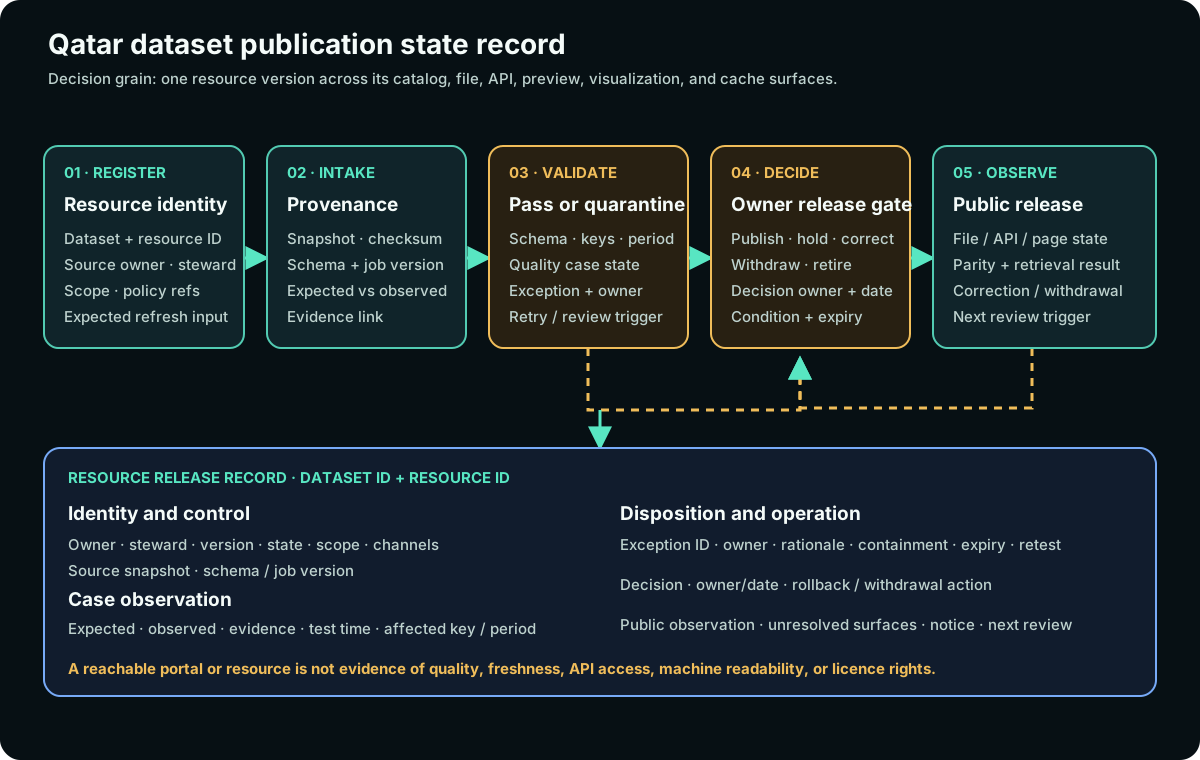
An open-data catalog can remain online while its operating truth quietly decays. A dataset page may still resolve even though its source extract stopped, a column changed meaning, a download differs from an API response, or a replacement release left an older file discoverable. Search and visualisation make such material easier to find; they do not make it current, authorized, reproducible, or safe to reuse.
The engineering unit should therefore be the named resource version, not the portal page. For each version, a team needs to know who owns the source, what was expected, what was actually observed, which evidence supports publication, which exception remains, and who made the release decision. Publication and withdrawal are controlled state changes. They are not the incidental result of a crawler succeeding or a content editor removing a link.
The State of Qatar Open Data portal provides direct official evidence that catalog discovery, data tools, visualisations, and links to policy, licence, handbook, and request material exist. Its policy page and handbook give owners visible references for review. Those observations support an operating discussion; they do not prove the condition of any dataset. A browser receiving a page does not establish that a resource is fresh, complete, machine-readable, reachable through an API, or reusable under a particular licence.
Make the release object smaller than the catalog entry
A catalog entry can contain several downloadable files, API endpoints, visualisations, geographic layers, or historical series. Treating the entry as one release hides divergent behavior. Instead, assign a resource ID to each independently refreshed or accessed representation. Couple it to a dataset ID, source-system ID, schema version, publication version, owner, steward, and consumer contact.
The boundary should state what the release includes and excludes. For example, a monthly table, its CSV export, and its API representation might form one reviewed release if they share a source snapshot and reconciliation test. A dashboard calculated from a different query is another object. Historical files need their own authority state: current, superseded but intentionally retained, corrected, withdrawn, or under investigation.
No public page can choose these meanings on behalf of a source organization. The source owner supplies authority, disclosure, classification, timing, and licensing decisions through the customer’s process. Engineering records those decisions and implements them. Qualified customer policy, legal, privacy, records, cybersecurity, accessibility, and sector reviewers resolve questions within their remit.
Use explicit states instead of a publish toggle
A useful workflow begins with registered, where the source, owner, intended resource, review scope, and expected schedule are recorded. In intake, the pipeline captures the source snapshot and technical provenance. A resource enters quarantined whenever required checks cannot run, a contract changes unexpectedly, authority is unclear, or observed results fail the owner-approved release rule.
owner-review is the point at which evidence is inspected and exceptions receive dispositions. Only a named decision can advance a version to published. After release, observed means the team is checking the real public representation rather than only trusting a successful internal job. correction-pending identifies an error with a bounded response plan. superseded preserves history while making the current version unambiguous. withdrawn prevents further serving through every in-scope surface and records why. retired closes a resource whose publication has ended under an approved decision.
These states should be machine-readable. Catalog metadata, pipeline orchestration, endpoint routing, alerting, and the decision register should agree. If an API serves a version marked withdrawn in the register, the mismatch is an incident. If a source is late but the page still says current, the catalog is masking a failure.
Text equivalent: dataset publication state record
The diagram above is a reference operating record. Its complete text equivalent is below so the decision fields remain usable without reading the image.
| Step or record | Required operational entry | Blocking or transition rule |
|---|---|---|
| Register | Dataset ID, resource ID, source owner, steward, intended audience, scope, exclusions, and review references | Do not ingest an unowned source or infer permission from public visibility |
| Intake | Source location, source snapshot time, checksum, extraction job version, schema version, and provenance link | Move to quarantine when the source cannot be reproduced or authority state is unknown |
| Validate | Expected schema, expected refresh window, expected row/key behavior, observed schema, observed refresh, and test evidence | Owner-approved checks must have observed results; a job-success flag is insufficient |
| Decide | Current state, exception ID, exception rationale, exception owner, expiry, proposed action, decision owner, and decision date | Only a recorded publish, hold, correct, withdraw, or retire decision changes public state |
| Publish and observe | Publication version, catalog URL, file/API identifiers, release timestamp, public retrieval result, parity result, and evidence links | Do not describe access or machine readability until the actual resource representation has been tested |
| Correct or withdraw | Affected versions and consumers, containment, corrected replacement or withdrawal action, observed propagation, unresolved copies, and next review | Keep the incident open until all in-scope surfaces and registered consumers have a disposition |
| Cover fields | Owner, version, state, expected, observed, evidence, exception, decision, reviewer, and next-review trigger | Blank evidence and blocked tests cannot be converted into a pass |
Validate what users receive, not just what the pipeline sent
A producer-side export is only one checkpoint. Release tests should fetch the public file or endpoint through the same route a user takes. Record response status, content type, size range, checksum where stable, encoding, delimiter, header set, schema, key uniqueness, null behavior, date and unit conventions, and a small set of owner-approved semantic assertions. For geographic or statistical data, inspect coordinate reference, aggregation level, revision marker, and time period where relevant.
Expected values must come from a versioned source contract, not from whatever last month happened to produce. Observed results belong beside them. A rule such as “required key is non-null” is meaningful only when the release record shows the observed failure count and the owner-approved disposition. Universal thresholds would be misleading because a harmless missing annotation and a missing identifier have different consequences.
API, bulk download, preview table, and visualisation should be reconciled where the product promises they represent the same release. Compare source snapshot IDs, schema versions, row or key aggregates, publication timestamps, and selected values. An API documentation link does not prove that an endpoint exists for every dataset, that credentials are available, or that the response matches a file. Test and record each promised interface.
Put change and withdrawal on the critical path
Schema drift is not only a parser problem. A renamed field can break a downstream dashboard; a changed category can alter a public trend; a revised geographic boundary can invalidate comparisons. The producer should classify the change, publish a machine-readable schema version, link a human change note, identify affected representations, and notify registered consumers according to the customer’s process.
Withdrawal needs the same rigor as publication. Disable or remove files and endpoints, invalidate caches, update catalog and search states, stop scheduled republishing, preserve the decision evidence under approved records instructions, and check mirrors or derived products that the operating boundary covers. If a resource is corrected rather than withdrawn, keep the relationship among erroneous, corrected, and superseding versions explicit. Quiet replacement destroys reproducibility.
A canary exercise can test this path without waiting for a real incident. Publish an approved synthetic resource, observe it through every surface, replace it, request the old version, then withdraw it and verify the expected result. The exercise should record expected and observed behavior, evidence locations, elapsed times for internal diagnosis, and unresolved exceptions. The acceptable timing is a customer decision, not a universal benchmark supplied by this article.
Treat licensing and disclosure as inputs, not metadata decoration
A populated licence field can still be wrong, ambiguous, version-specific, or inapplicable to one component of a dataset. Engineering can require a licence decision reference, expose attribution text, bind that reference to a resource version, and prevent publication when the required input is missing. It cannot decide legal effect or grant reuse rights.
Likewise, technical redaction and field suppression can implement an approved disclosure decision, but they cannot determine whether publication is lawful or appropriate. Reviewers need source fields, transformations, aggregation, small-cell or inference concerns where relevant, attachments, free text, historical versions, and the evidence behind any exception. The presence of open-data policy and handbook pages is a prompt to consult the current official material, not permission to generalize.
Operate the catalog as a queue of accountable decisions
Dashboards should show resources awaiting owner review, missed expected refreshes, changed contracts, failed public fetches, parity differences, expired exceptions, unresolved corrections, and withdrawals that have not propagated. Alerts must point to a resource ID and decision owner. A generic “pipeline failed” alarm leaves operators to rediscover the release boundary during an incident.
The review meeting can then work from evidence rather than screenshots. For each candidate version, the owner sees the source snapshot, expected checks, observed results, interface reconciliation, policy references, exceptions, consumer impact, and proposed state. The decision is deliberately narrow: publish this version, publish with a recorded condition, hold it, correct it, withdraw it, or retire the resource. It is not a declaration that the portal or every dataset is high quality.
That discipline makes a catalog useful over time. Discovery remains the visible service, but controlled state, resource-level evidence, correction, withdrawal, and named ownership make the published material inspectable and recoverable.
Annotated primary sources
What the public material supports—and what it does not
These official pages provide bounded public context. They do not prescribe this design, decide a customer’s obligations, or establish any LangData affiliation or conformity.
-
1.State of Qatar Open Data portal
Supports: The official portal visibly provides catalog discovery, data tools, visualizations, and links to policy, licence, handbook, and dataset-request material.
Boundary: Portal reachability does not establish the quality, freshness, completeness, machine readability, API availability, access conditions, or licensing rights of any individual resource.
-
2.State of Qatar Open Data Policy page
Supports: The official portal maintains a dedicated open-data policy reference that dataset owners and qualified reviewers can inspect during publication decisions.
Boundary: This article does not interpret the policy, determine who must publish, decide disclosure or privacy questions, or conclude that a dataset or workflow conforms.
-
3.State of Qatar Open Data Handbook
Supports: The official portal provides a handbook reference alongside its catalog and policy material, making owner-facing guidance part of the visible publication context.
Boundary: The handbook does not prescribe this architecture or prove that a particular source, metadata record, download, API, licence, refresh process, or LangData implementation is acceptable.
Review the operating boundary before choosing the stack.
Bring one workflow, its approved source inventory, and the people who own authorization, review, and incidents.
Discuss the architecture review