Topic review
UAE data architecture review: decisions and evidence across governance and hosting boundaries
A workload-level method for comparing UAE hosting and data-governance options without turning sovereignty, residency, security, or sector questions into universal architecture claims.
- Published by
- LangData Editorial, Editorial and architecture team
- Review owner
- Sourav Chandra, Co-Founder, LangData · Approved
- Published
- Updated
Swipe or scroll horizontally to inspect the full diagram.
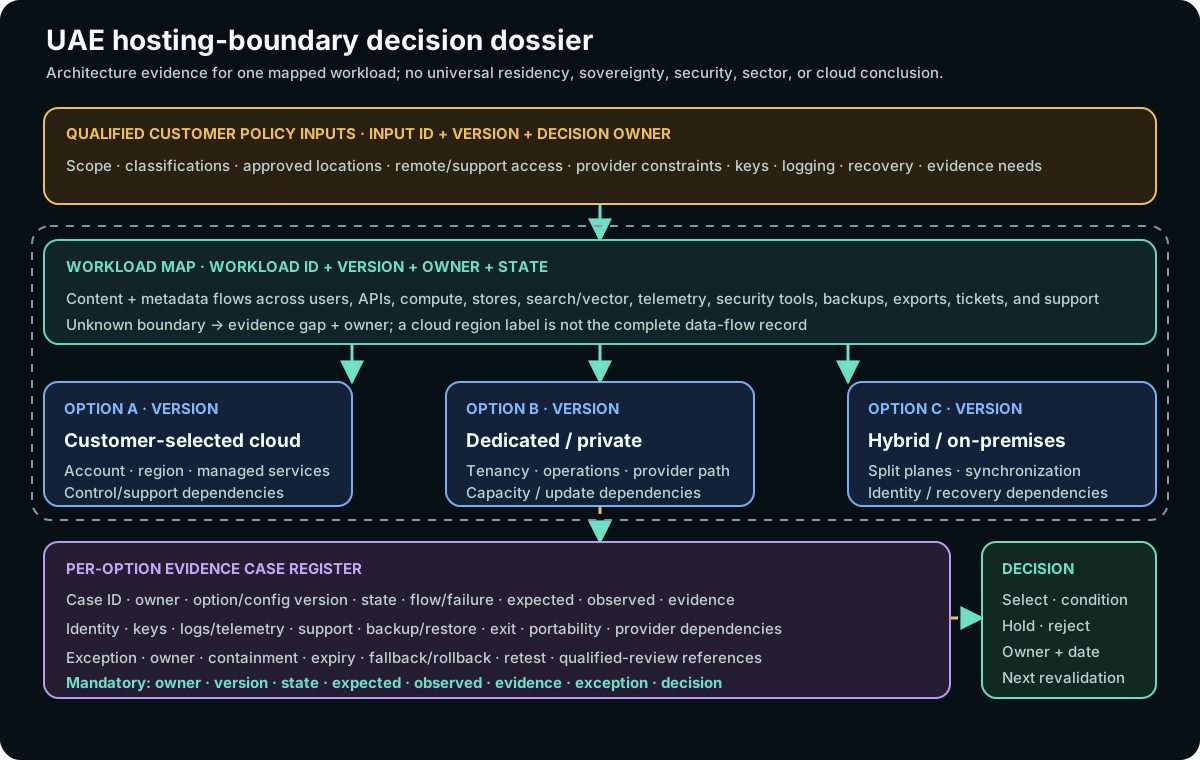
“Sovereign cloud” sounds like a topology, but the decisions hidden inside it are not a single product feature. Where does a customer record travel during support? Who controls identity and encryption keys? Which logs contain payloads? Can a backup be restored into another location? Does a managed service replicate metadata or telemetry? Which organization can change policy, and which people can operate the workload during an incident?
A UAE data architecture review should replace the adjective with a workload decision dossier. The dossier records customer-approved policy inputs, maps every data flow and operational dependency, compares feasible placement options, executes evidence cases, exposes exceptions, and routes legal, privacy, cybersecurity, procurement, records, cloud, and sector conclusions to qualified customer reviewers. Engineering shows what an option does. It does not announce what every UAE workload must do.
The official UAE Government Data page provides public data and open-data context. The Regulatory framework page indexes a range of digital topics. The UAE Digital Government Strategy 2025 describes visible dimensions including resilience, user-driven design, data-driven operation, and openness, while Digital UAE gives wider federal context.
Those pages are source material for customer review. They do not select a cloud, determine an organization’s requirements, or establish that one option is compliant, sovereign, or approved.
Bound the workload before asking where it should run
Give the workload a stable ID and version. Name its purpose, business owner, users, customers or residents affected, data subjects or entities as classified by the customer, source systems, outputs, operators, and decision consequence. Include development, test, disaster recovery, analytics, machine-learning, support, and archival paths; sensitive copies often appear outside the primary environment.
Map data categories at field-group level with the customer’s classification references. Follow them through browser or device, edge, network, identity service, API gateway, queue, compute, database, object store, search or vector index, cache, observability, security tooling, key service, backup, export, operator workstation, ticket, and vendor support system. Record both content and metadata. Identifiers, prompts, query text, filenames, IP addresses, and diagnostic traces can cross boundaries even when primary records do not.
State exclusions and discovery gaps. If provider documentation cannot establish where one telemetry stream is processed, mark it unknown and assign an owner. A region label on a console is not evidence for every control-plane, support, billing, security, or recovery flow.
Keep policy decisions external and versioned
The customer’s qualified reviewers provide decision inputs: applicable entities and sectors, data classifications, approved locations, transfer or remote-access positions, provider and subcontractor constraints, encryption and key expectations, identity separation, logging and retention, recovery, incident response, records, audit, and evidence needs. Each input receives an ID, owner, source, effective date, version, affected workload, and review trigger.
Engineers should not infer these inputs from a country name or an official index. They can identify questions and show technical consequences. If an input changes, the dossier can query which option, resource, interface, backup, vendor, or exception depends on the old version.
The distinction also improves language. Instead of “UAE data must remain in topology X,” the record can say, “Customer policy input P-17 requires these field groups and copies to use approved locations; option O-2 was tested against that input; qualified reviewers accepted the observed evidence with exception E-4.” That statement is narrower, current, and auditable.
Text equivalent: hosting-boundary option dossier
The diagram’s full text alternative appears below. It can be used as the review cover sheet without requiring the SVG.
| Dossier section | Required fields | Review outcome |
|---|---|---|
| Workload cover | Workload ID/version, purpose, owner, users, environments, scope, exclusions, customer classifications, state, and reviewers | Defines the system for which the decision is valid |
| Policy inputs | Input ID/version, decision owner, source record, approved requirement or constraint, affected fields/flows, effective date, and revalidation trigger | Keeps legal, security, sector, and risk interpretation outside architecture invention |
| Option definition | Option ID/version, provider and services, account/tenant boundary, locations, control-plane dependencies, subcontractor/support paths, and portability limits | Makes each topology specific enough to test |
| Evidence case | Case ID, flow or failure, expected result, observed result, configuration version, evidence link, tester, and state | Shows behavior rather than relying on labels or documentation alone |
| Control planes | Identity owner, privileged access, key ownership, encryption boundaries, logs/telemetry, backup/restore, support access, update path, and incident evidence | Exposes secondary paths that can change the decision |
| Exception | Exception ID, affected input and flow, rationale from the right reviewer, containment, owner, expiry, retest, and fallback | Prevents an unknown or deviation from disappearing in prose |
| Decision | Selected option or hold/reject, decision owner/date, qualified-review references, conditions, prohibited uses, migration/rollback, and next-review trigger | Records one customer decision, not a universal UAE rule |
| Required operational terms | Owner, version, state, expected, observed, evidence, exception, and decision | Ensures every conclusion can be traced to an observation |
Compare real options at data-flow level
Options may include a customer-selected public-cloud region, dedicated tenancy, customer-controlled subscription or account, private cloud, colocation, on-premises deployment, split control/data planes, or a hybrid arrangement. These are design patterns, not recommendations for all workloads. Compare only feasible variants that meet the customer’s initial constraints and operational capability.
For each flow, record location and responsible party for processing, persistent storage, transient storage, replication, logs, backup, key material, control-plane operations, support, and deletion. Note provider dependencies that cannot be moved, services unavailable in a selected location, and features that change failover behavior. A split architecture may reduce one boundary while introducing synchronization, identity, observability, and recovery complexity.
Document portability honestly. Can data be exported in usable formats? Can keys, identity mappings, policies, lineage, logs, model artifacts, and infrastructure configuration be reconstructed? What is the observed time and manual work for exit? Contractual rights and legal conclusions remain with qualified reviewers; engineering supplies inventories and exercises.
Test identity, keys, and support as separate planes
Identity cases should cover workforce and service identities, federation failure, stale groups, privileged elevation, break-glass access, revoked staff, vendor support, and cross-environment isolation. Record expected denial or access, observed policy decision, logs, and evidence. A private network does not compensate for an uncontrolled administrative role.
Key evidence should identify who administers keys, where operations occur, service dependencies, rotation, revocation, recovery, separation of duties, and what happens when the key service is unavailable. “Customer-managed” can describe several arrangements; the dossier must show observed control and provider behavior. Qualified customer security and risk reviewers decide sufficiency.
Support is a data flow. Capture diagnostic bundles, screen sharing, ticket attachments, command execution, emergency access, approval, session recording where approved, and retention. Test whether support can operate without payload access, whether emergency access is visible, and whether revocation works. Do not assume a contract summary matches actual configuration.
Treat logs, backup, and recovery as architecture decisions
Observability can copy sensitive content into a separate service with different access and retention. Inventory application logs, traces, metrics dimensions, security events, database audit, provider activity, and data-loss-prevention findings. Test approved redaction and access. Preserve enough correlation and configuration evidence for investigation without turning the log platform into an unrestricted duplicate dataset.
Backups need location, encryption/key dependency, immutability setting, retention input, operator roles, catalog, deletion or expiry behavior, and restore destination. Execute restores into an approved isolated environment. Observe whether identity, policy, keys, network, and dependent services recover together. A backup-success message is not restore evidence.
Resilience may involve multi-zone, multi-region, private-site, or manual recovery options. The customer decides which locations and failure assumptions are acceptable. Test loss of identity, key service, provider service, network path, operator access, and one critical dependency. Record degraded behavior and communication ownership.
Make provider evidence and runtime evidence meet
Architecture review combines provider documents, customer contracts, service configuration, resource inventory, policy exports, activity logs, network observations, support records, test results, and recovery evidence. Provider material can state a feature or responsibility; runtime evidence shows whether the customer configured and observed it for this workload. Neither should be stretched into a certification claim.
Track document and service versions. Cloud behavior changes, features are added, support arrangements change, and subcontractors or service dependencies may be updated. Define a revalidation trigger for provider changes, new data classes, new emirates or sectors in scope, expanded support, new managed services, failover changes, material incidents, or policy-input revisions.
Record a reversible, qualified decision
The review board should see the workload map, policy inputs, option definitions, evidence cases, failed and blocked tests, provider dependencies, exceptions, cost and operational implications, recovery result, migration route, and exit route. Specialist reviewers record applicability and acceptance in customer-controlled records. Engineering does not sign for them.
A valid decision can select one option, accept it with bounded conditions, require more evidence, or reject all candidates. Every condition has an owner, scope, expiry, and retest. The decision names prohibited uses so that a later team cannot apply it to a different workload by analogy.
This method makes “sovereign cloud” a question that can be answered precisely rather than a marketing label. The defensible output is a versioned customer decision about one mapped workload and a tested option, supported by observed identity, key, logging, support, backup, recovery, and dependency evidence. It is not a claim that the topology is required, sufficient, or approved for every organization in the UAE.
Annotated primary sources
What the public material supports—and what it does not
These official pages provide bounded public context. They do not prescribe this design, decide a customer’s obligations, or establish any LangData affiliation or conformity.
-
1.Data — The Official Platform of the UAE Government
Supports: The official UAE Government page presents public context for data, open-data policies and strategies, and government use and promotion of data.
Boundary: It does not determine a customer's data classification, hosting location, access rights, transfer position, security controls, sector obligations, data quality, or suitability of an architecture option.
-
2.Regulatory framework — The Official Platform of the UAE Government
Supports: The official page indexes multiple digital-government regulatory topics, including electronic transactions, API First, digital properties, information access, sandboxes, and maturity material.
Boundary: An index is a review trigger, not a complete or universally applicable rule set; this article does not interpret current law, policy, emirate requirements, sector requirements, or conformity.
-
3.The UAE Digital Government Strategy 2025
Supports: The official page describes a cross-sectoral digital-government strategy and visible dimensions including resilience, user-driven design, data-driven operation, and openness.
Boundary: It does not prescribe this dossier, establish current implementation by every entity, mandate one cloud topology, or prove LangData alignment, participation, delivery, or approval.
-
4.Digital UAE — The Official Platform of the UAE Government
Supports: The official overview provides federal digital-government context and links to data, strategies, services, and regulatory material.
Boundary: The overview neither resolves workload-specific residency or sovereignty questions nor grants procurement status, system access, certification, or a government relationship.
Review the operating boundary before choosing the stack.
Bring one workflow, its approved source inventory, and the people who own authorization, review, and incidents.
Discuss the architecture review